
The Complete Guide to Garage Floor Epoxy Near Me in Austin: Costs, Benefits, and Local Installation Options
Quick Answer
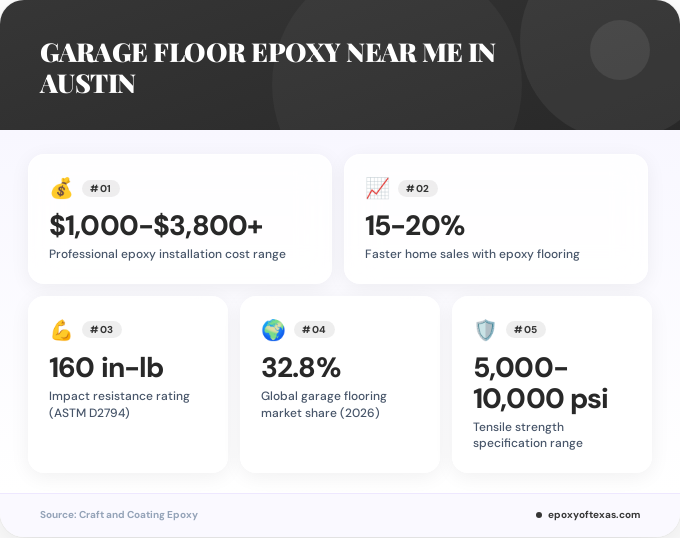
Garage floor epoxy near me in Austin typically costs between $1,000 and $3,800+ depending on garage size, surface preparation needs, and finish quality, with professional installation ensuring UV-stable, heat-resistant coatings ideal for Texas summers. Local providers deliver durable solutions that can help homes sell 15-20% faster, while offering impact resistance exceeding 160 in-lb and chemical resistance for oils, solvents, and traffic.
Searching for “garage floor epoxy near me in Austin” reveals a transformation happening in garages across central Texas. What was once a utilitarian space for parking and storage has evolved into a design-forward extension of the home, and epoxy flooring sits at the center of this shift. With 32.8% of the global garage flooring market belonging to epoxy solutions in 2026, homeowners in neighborhoods from Westlake to Pflugerville are discovering why this durable, versatile coating has become the gold standard.
Austin’s unique climate presents specific challenges for garage flooring: intense summer heat, occasional humidity, and the relentless Texas sun that can fade inferior coatings within months. Yet professional epoxy installations address these issues head-on, offering UV-stable finishes that maintain their appearance and performance for decades. The numbers tell a compelling story: epoxy-coated garage floors contribute to homes selling 15-20% faster in competitive Austin markets, making this upgrade both a lifestyle enhancement and a smart investment.
What Is Garage Floor Epoxy and Why Is It Popular in Austin?
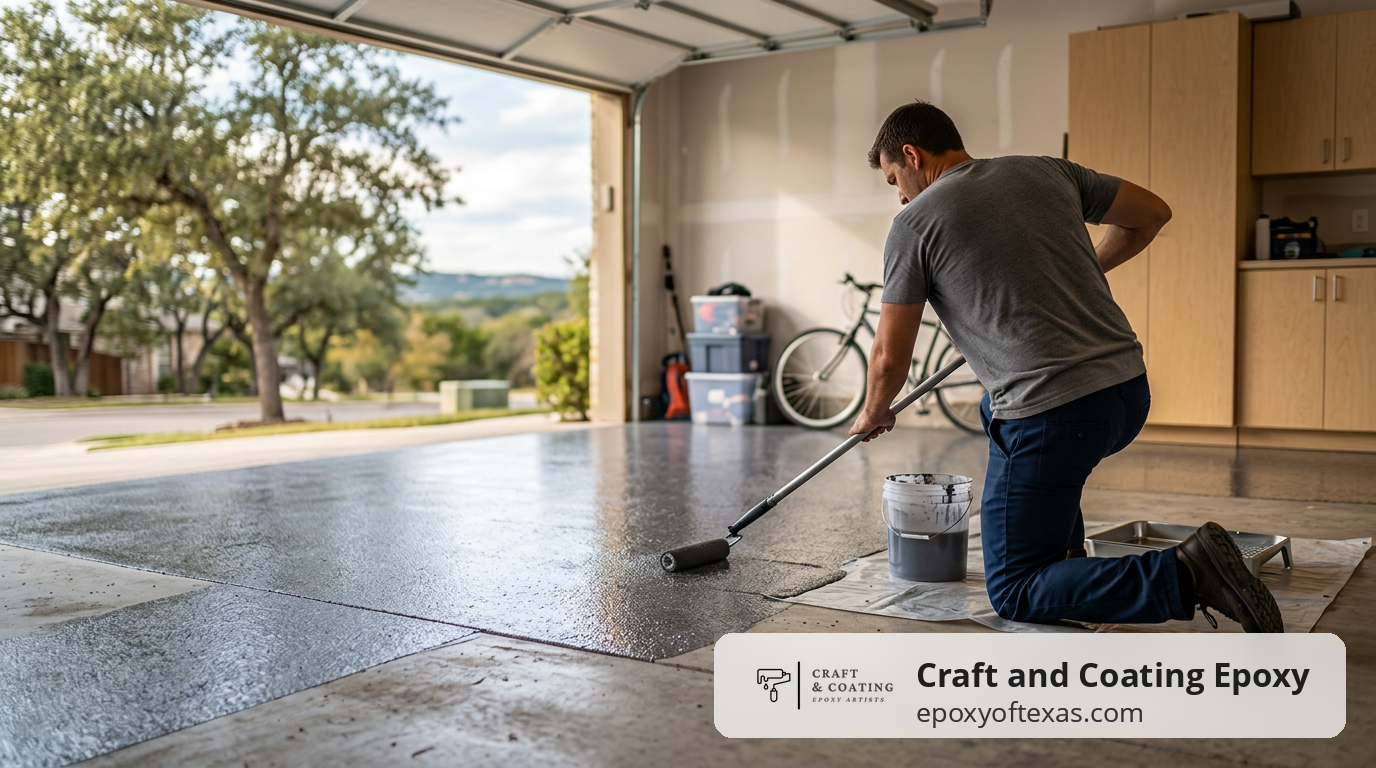
Garage floor epoxy is a high-performance resin coating system that bonds chemically to concrete surfaces, creating a seamless, durable layer that resists chemicals, impacts, and heavy traffic. Unlike simple paints that sit on top of concrete, epoxy penetrates and adheres at a molecular level, forming a protective shell that can withstand the demands of vehicle traffic, spills, and temperature fluctuations.
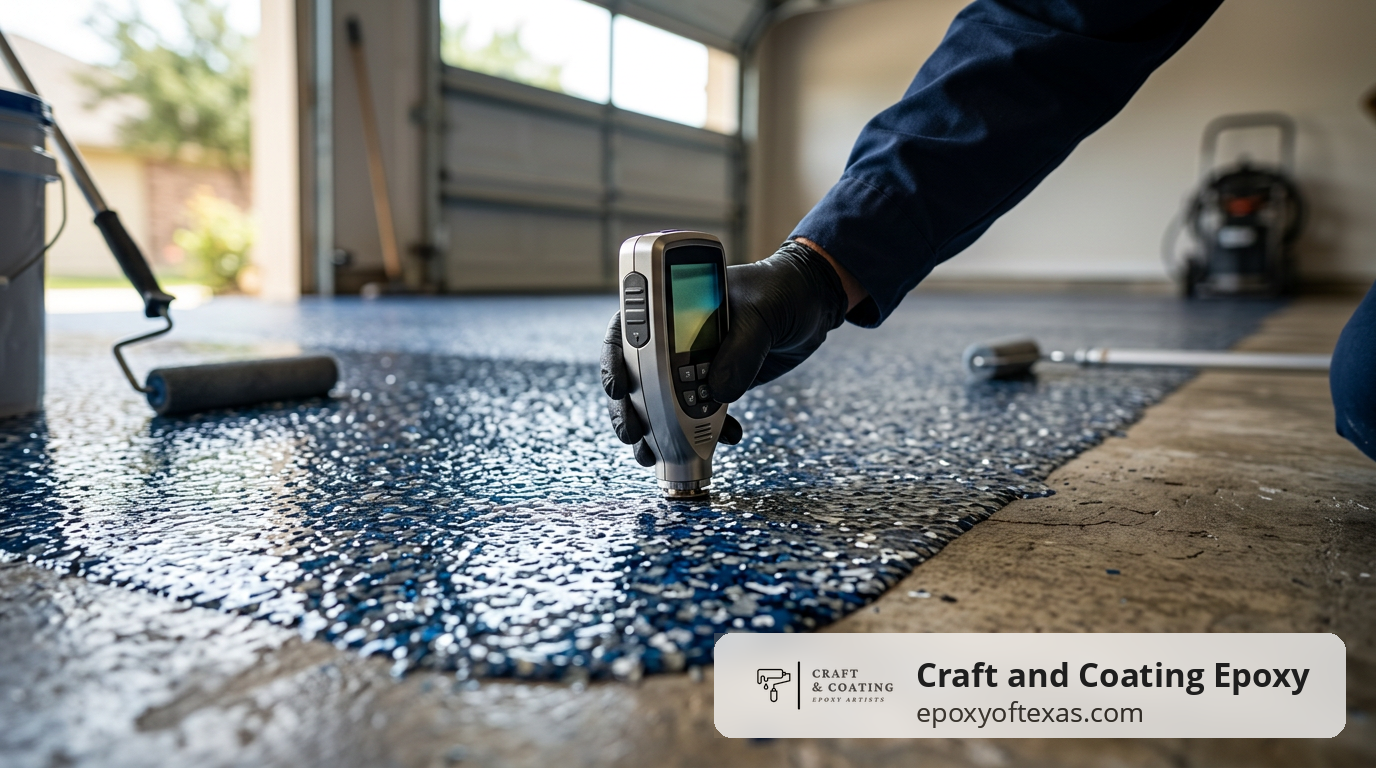
The coating system typically consists of multiple layers: a primer or base coat that ensures adhesion, decorative flakes or color chips that add visual interest and texture, and a clear topcoat that provides UV protection and final durability. Standard epoxy coatings demonstrate impressive specifications, including tensile strength between 5,000-10,000 psi, impact resistance exceeding 160 in-lb according to ASTM D2794 standards, and salt spray resistance surpassing 1,000 hours per ASTM B117 testing protocols.
In Austin specifically, epoxy’s popularity stems from its ability to handle extreme conditions while offering aesthetic versatility. From the sleek modern homes in Travis Heights to the suburban garages of Round Rock, homeowners appreciate that professional epoxy installations can match any design vision while delivering practical benefits that matter in Texas: heat resistance, moisture barriers, and protection against the oils, solvents, and chemicals common in garage environments.
How Much Does Garage Floor Epoxy Cost in Austin?
When researching garage floor epoxy near me in Austin, understanding pricing structures helps homeowners budget appropriately for this significant upgrade. Professional installations involve multiple cost factors that extend far beyond the epoxy itself, making pricing highly variable based on your specific project requirements.
For a standard single-car garage measuring approximately 250-300 square feet, professional epoxy installation typically ranges from $1,000 to $2,000+. This pricing includes comprehensive surface preparation, crack repair, grinding or shot blasting to ensure proper adhesion, application of a base coat, decorative flake broadcasting, and a protective UV-stable topcoat. Two-car garages spanning 400-500 square feet generally see pricing between $1,800 and $3,800+, with variations based on the complexity of existing conditions and desired finish quality.
However, these figures represent starting points rather than fixed averages. Pricing varies significantly based on several critical factors:
- Surface condition: Existing coatings requiring removal, extensive cracking, or moisture issues increase preparation time and material costs substantially
- Coating system: Standard epoxy, polyaspartic hybrids, metallic finishes, and specialty formulations each carry different material costs and application requirements
- Customization level: Custom colors, intricate patterns, logos, or multi-tone designs require additional labor and expertise
- Topcoat selection: UV-stable, chemical-resistant, or ultra-clear topcoats provide enhanced performance at premium pricing
- Geographic location: Projects in central Austin versus surrounding suburbs may experience cost differences based on accessibility and market conditions
| Garage Size | Square Footage | Typical Investment Range |
|---|---|---|
| Single Car | 250-300 sq ft | $1,000 – $2,000+ |
| Two Car | 400-500 sq ft | $1,800 – $3,800+ |
| Three Car / Oversized | 600+ sq ft | $3,000 – $6,000+ |
Premium installations emphasizing value and longevity naturally command higher investment levels. Quality contractors focus on proper surface preparation, which accounts for 70-80% of a successful epoxy installation. Cutting corners on prep work leads to premature failure, while meticulous attention to substrate preparation ensures decades of performance.
For accurate pricing tailored to your specific garage conditions, design preferences, and performance requirements, contacting local Austin epoxy specialists for custom quotes remains essential. Every project presents unique characteristics that influence final investment requirements, from existing coating removal needs to desired finish aesthetics.
What Do 2026-2027 Market Statistics Tell Us About Epoxy Flooring?
The epoxy flooring industry demonstrates robust growth and market dominance heading into 2027, with statistics revealing why this coating technology continues gaining traction among homeowners and commercial facilities alike. These numbers provide context for the value proposition that Austin residents experience when selecting epoxy for their garage floors.
Epoxy flooring commands an impressive 40% share of the total resinous flooring market in 2026, reflecting widespread adoption across residential, commercial, and industrial applications. Within the garage flooring segment specifically, epoxy holds 32.8% market share, driven by its unmatched combination of durability, chemical resistance, and versatility for handling heavy vehicle traffic and petroleum-based fluids.
The United States floor coatings market reached USD 1.99 billion in 2026, with projections showing growth at a 4.12% CAGR to USD 2.43 billion by 2031. Within this expanding market, epoxy maintains a commanding 41.70-42.35% share, attributed to its exceptional lifecycle performance in both industrial facilities and residential garages. This dominance reflects epoxy’s proven track record: properly installed systems deliver 10-20+ years of service life with minimal maintenance requirements.
Residential garage flooring specifically claims 33.8% of the global garage flooring market in 2026, as homeowners increasingly view garages as extensions of living spaces worthy of quality finishes. Market research indicates that renovation demand and bio-based epoxy innovations drive continued sector expansion, with sustainability-conscious formulations gaining traction among environmentally aware consumers.
These statistics underscore a fundamental reality: epoxy flooring has evolved from a niche industrial product to a mainstream residential upgrade with proven performance metrics, broad market acceptance, and strong growth trajectories that validate its position as the premier garage flooring solution.
Why Should Austin Homeowners Choose Epoxy Flooring?
The decision to install epoxy flooring in your Austin garage extends beyond simple aesthetics, encompassing practical benefits that address the specific challenges Texas homeowners face. Understanding these advantages helps explain why epoxy continues gaining market share and why homes with professionally installed epoxy floors enjoy faster sale times.
Durability and Longevity: Epoxy creates an impact-resistant surface capable of withstanding dropped tools, heavy equipment, and vehicle traffic without chipping or cracking. With proper installation and maintenance, epoxy floors deliver 10-20+ years of reliable service, far exceeding the lifespan of concrete sealers or garage floor paints.
Chemical and Stain Resistance: Automotive fluids, gasoline, brake fluid, and household chemicals bead on epoxy surfaces rather than penetrating and staining. This resistance proves invaluable in garage environments where spills occur regularly, enabling easy cleanup with simple mopping or wiping.
Enhanced Safety Features: Decorative flakes incorporated into epoxy systems provide subtle texture that improves traction, particularly important when surfaces become wet from tracked-in rain or vehicle condensation. This slip resistance enhances safety without compromising the smooth, professional appearance.
Light Reflectivity and Brightness: Epoxy’s glossy finish reflects available light, effectively brightening garage interiors and reducing the need for additional lighting. This reflectivity proves especially beneficial in garages used as workshops, home gyms, or hobby spaces where visibility matters.
Easy Maintenance Requirements: Unlike bare concrete that harbors dust and stains, epoxy’s seamless surface resists dirt accumulation and cleans effortlessly. Regular sweeping and occasional mopping maintain appearance without specialized products or extensive effort.
Home Value Enhancement: Data shows that Austin homes featuring epoxy garage floors sell 15-20% faster than comparable properties with untreated concrete, as buyers increasingly prioritize move-in-ready upgrades and low-maintenance features. This accelerated sale velocity often translates to stronger negotiating positions and reduced carrying costs.
Design Versatility: From subtle neutral tones that complement any home style to bold metallic finishes that make dramatic statements, epoxy accommodates diverse aesthetic preferences. Custom colors, patterns, and decorative elements enable personalization that reflects individual taste and home architecture.
How Does Austin’s Climate Impact Epoxy Floor Performance?
Austin’s climate presents unique considerations for garage flooring materials, with temperature extremes, UV exposure, and humidity patterns that demand coating systems specifically engineered for Texas conditions. Understanding these environmental factors explains why UV-stable, professionally installed epoxy systems outperform generic solutions in central Texas applications.
Summer temperatures in Austin regularly exceed 100°F, with garage floor surfaces exposed to direct sunlight experiencing even higher thermal stress. Inferior coatings without proper UV stabilization fade, yellow, or chalk under this intense exposure, deteriorating aesthetically and structurally within months. Professional-grade epoxy systems incorporate UV-stable topcoats that maintain color integrity and gloss retention despite relentless sun exposure.
Thermal expansion and contraction cycles challenge flooring adhesion as concrete substrates expand in heat and contract in cooler conditions. Epoxy’s chemical bond to concrete creates a flexible yet durable connection that accommodates these movements without delaminating or cracking. This flexibility proves essential in Austin, where temperature swings between summer highs and winter lows can span 60+ degrees.
Humidity variations throughout the year create moisture dynamics that impact coating performance. Spring and early summer often bring elevated humidity levels that can interfere with epoxy curing if installations occur during unfavorable conditions. Experienced contractors schedule installations during optimal weather windows and employ moisture testing protocols to ensure substrate readiness, preventing adhesion failures caused by trapped moisture vapor.
The intense Texas sun also creates temperature differentials between shaded and exposed garage areas, particularly in partially open or workshop-style garages common in suburban Austin neighborhoods. Professional installations account for these variations through proper material selection and application techniques that ensure uniform performance across the entire floor surface.
Austin’s occasional severe weather events, including heavy rainfall and rare freeze conditions, further test flooring durability. Epoxy’s moisture resistance prevents water penetration that could damage concrete or cause mold growth, while its impact resistance withstands debris and equipment movement during storm preparation activities.
Should You DIY or Hire a Professional for Epoxy Installation?
The proliferation of consumer-grade epoxy kits at home improvement retailers raises an important question for Austin homeowners: does DIY installation deliver comparable results to professional services, or do the cost savings come with hidden compromises? The answer significantly impacts long-term satisfaction and investment return.
DIY epoxy kits typically cost $200-600 for materials covering a two-car garage, creating apparent savings compared to professional installation pricing. However, these kits employ lower-grade resins with reduced solids content, often delivering only 30-50% of the performance characteristics found in professional-grade systems. Thinner applications provide less durability, reduced chemical resistance, and shorter service life.
More critically, successful epoxy installation depends overwhelmingly on proper surface preparation, a process requiring specialized equipment and expertise. Professional concrete preparation involves diamond grinding or shot blasting to open concrete pores, remove contaminants, and create the surface profile necessary for chemical bonding. DIY approaches using rental equipment rarely achieve equivalent preparation quality, resulting in premature coating failure despite proper application technique.
Existing coatings, sealers, or contaminants present even greater challenges for DIY installers. Many Austin garages have previous coatings that must be completely removed before new epoxy application. Incomplete removal leaves islands of old material that prevent proper adhesion, causing new coatings to peel or delaminate within months. Professional contractors employ industrial grinding equipment and thorough cleaning protocols that ensure complete contaminant removal.
Environmental conditions during installation critically impact curing chemistry. Concrete temperature, ambient temperature, humidity levels, and dew point calculations all influence whether epoxy cures properly or experiences problems like blushing, poor adhesion, or incomplete hardening. Professional installers monitor these variables and adjust application timing accordingly, while DIY enthusiasts often lack the knowledge or equipment to make these assessments.
The investment differential becomes clearer when considering lifecycle value. Professional installations delivering 15-20 years of service with minimal maintenance compare favorably against DIY applications requiring replacement after 2-5 years. Factor in the 15-20% faster home sale velocity associated with professional installations, and the value proposition shifts decisively toward professional services for homeowners viewing epoxy as a long-term investment rather than a temporary cosmetic upgrade.
For Austin homeowners seeking results that justify the investment and enhance property value, professional installation remains the recommended approach. While capable DIY enthusiasts can achieve acceptable results with perfect execution and ideal conditions, the margin for error leaves most homeowners better served by experienced contractors who guarantee their work and bring industrial-grade materials to every project.
How Do You Choose the Right Epoxy Contractor in Austin?
Selecting the right epoxy flooring contractor in Austin requires evaluating multiple factors beyond price quotes, as installation quality directly determines long-term performance and satisfaction. A systematic approach to contractor selection protects your investment and ensures results that meet expectations.
Verify Experience and Specialization: Seek contractors who specialize in epoxy flooring rather than general handypersons who offer flooring among dozens of services. Specialized epoxy contractors possess deep knowledge of surface preparation techniques, product chemistry, and application methods that generalists lack. Request examples of recent Austin installations and ask specific questions about surface prep protocols.
Examine Portfolio and References: Quality contractors maintain portfolios showcasing diverse project types, finish options, and problem-solving examples. Request references from recent clients in Austin neighborhoods, then contact those homeowners to discuss their experiences with installation quality, timeline adherence, and post-installation support.
Assess Product Quality and Options: Professional-grade epoxy systems differ dramatically from consumer products in solids content, chemical formulation, and performance specifications. Inquire about the specific products contractors use, requesting technical data sheets that document tensile strength, impact resistance, and chemical resistance specifications. Contractors using premium systems can provide this documentation readily.
Understand Preparation Processes: Surface preparation determines 70-80% of installation success. Ask detailed questions about how contractors prepare surfaces: grinding depth, contaminant removal methods, crack repair techniques, and moisture testing protocols. Contractors who gloss over preparation details or suggest shortcuts raise red flags about quality commitment.
Review Warranty Terms: Comprehensive warranties covering both materials and labor demonstrate contractor confidence in their work. Understand warranty duration, what conditions void coverage, and how warranty claims get processed. Lifetime warranties sound impressive but often contain exclusions that limit practical protection.
Evaluate Communication and Professionalism: Initial interactions reveal much about how contractors operate. Prompt communication, detailed written estimates, clear explanations of processes, and professional presentation suggest similar diligence during installation. Contractors who miss appointments, provide vague answers, or pressure immediate decisions often deliver comparable service quality.
Confirm Licensing and Insurance: Verify that contractors maintain appropriate business licenses, liability insurance, and workers’ compensation coverage. These protections shield homeowners from liability if accidents occur during installation and demonstrate contractor legitimacy and professionalism.
Compare Value Rather Than Just Price: The lowest bid rarely delivers the best value when comparing professional installations. Focus on what each quote includes: preparation depth, coating system quality, warranty terms, and included services. A mid-range quote from an experienced contractor using premium materials typically outperforms low bids using inferior products or minimal prep work.
What Are the Latest Garage Epoxy Trends in 2026?
The garage epoxy industry continues evolving rapidly, with 2026 bringing innovations in materials, aesthetics, and functional applications that reflect changing homeowner priorities and technological advances. Understanding these trends helps Austin residents make forward-looking decisions that maintain relevance and appeal for years to come.
Design-Forward Finishes: Epoxy has transcended purely utilitarian applications to embrace bold aesthetic statements. Metallic finishes creating depth and movement, custom color matching that coordinates with home palettes, and intricate patterns rivaling interior flooring in sophistication represent the new standard. Austin homeowners increasingly view garage floors as design opportunities rather than afterthoughts.
Multi-Functional Space Integration: Garages serving as home gyms, workshops, entertainment areas, and hobby spaces drive demand for flooring that supports these diverse uses. Epoxy’s seamless, easy-to-clean surface accommodates exercise equipment, work benches, and recreational activities while maintaining professional appearance. Industry trend reports note declining interest in traditional “man cave” concepts, replaced by versatile spaces serving entire households.
Polyaspartic Hybrid Systems: Fast-curing polyaspartic topcoats applied over epoxy base layers combine the best attributes of both technologies. These hybrid systems cure overnight rather than requiring multi-day wait times, enable installation across wider temperature ranges, and deliver enhanced UV resistance. The faster turnaround particularly appeals to busy Austin families minimizing vehicle displacement during installation.
Low-VOC and Eco-Conscious Formulations: Environmental awareness drives demand for coatings with reduced volatile organic compound emissions and bio-based content. Manufacturers respond with formulations meeting stringent air quality standards while maintaining performance characteristics, appealing to health-conscious homeowners and environmentally responsible builders.
Smart Surface Technologies: Emerging innovations include antimicrobial additives that inhibit bacterial growth, static-dissipative formulations for electronics workshops, and temperature-indicating pigments. While still primarily commercial applications, these technologies increasingly appear in high-end residential installations as homeowners seek cutting-edge functionality.
Texture and Safety Enhancements: Beyond decorative flakes, contractors now offer graduated texture levels optimized for specific uses. Light texture suits standard parking and storage, while more aggressive profiles benefit workshop areas where standing for extended periods or handling equipment requires maximum slip resistance.
Regional Production and Supply Chains: Market analysis shows increasing US-based epoxy production to reduce costs and improve supply reliability. This domestic manufacturing growth benefits Austin contractors and homeowners through more predictable pricing, shorter lead times, and reduced exposure to international supply disruptions.
Key Takeaways
- Professional garage floor epoxy installation in Austin ranges from $1,000 to $3,800+ depending on garage size, surface conditions, and coating quality, with pricing varying significantly based on specific project requirements and customization preferences.
- Epoxy flooring commands 32.8% of the global garage flooring market and 40% of the resinous flooring segment, demonstrating proven performance with tensile strength of 5,000-10,000 psi and impact resistance exceeding 160 in-lb.
- Austin’s climate demands UV-stable epoxy systems designed to withstand intense summer heat, temperature cycling, and sun exposure that degrades inferior coatings within months of installation.
- Homes featuring professionally installed epoxy garage floors in Austin sell 15-20% faster than comparable properties, reflecting buyer preference for move-in-ready upgrades and low-maintenance features.
- Proper surface preparation accounts for 70-80% of installation success, requiring professional equipment and expertise that DIY approaches rarely achieve consistently.
- 2026 trends emphasize design-forward finishes, multi-functional space integration, polyaspartic hybrid systems for faster curing, and eco-conscious formulations meeting environmental standards.
- Professional epoxy installations deliver 10-20+ years of service life compared to 2-5 years for typical DIY applications, making the long-term value proposition decisively favor professional contractors.
People Also Ask
Is epoxy flooring worth it for Austin garages?
Yes, epoxy flooring proves worth the investment for high-traffic garages in Austin, offering chemical resistance, durability against Texas heat, and contributing to faster home sales. Professional installations deliver 10-20+ years of service while enhancing garage functionality and aesthetics, though homeowners should prepare for multi-day installation processes and temporary vehicle displacement.
How long does garage epoxy last in Texas heat?
Professional-grade epoxy with UV-stable topcoats lasts 10-20+ years in Texas heat when properly installed with adequate surface preparation. The coating’s chemical bond to concrete and thermal flexibility accommodate temperature cycling, while UV protection prevents the fading and degradation that affects inferior products within months of Austin sun exposure.
Should I remove old garage floor coating before applying epoxy?
Yes, existing coatings must be completely removed before new epoxy application to ensure proper chemical adhesion. Incomplete removal leaves contaminant islands that cause new coatings to peel or delaminate within months, making professional grinding or shot blasting essential for installations over previously coated surfaces.
Will epoxy garage floors fade in Austin sunlight?
Professional epoxy systems incorporating UV-stable topcoats resist fading in Austin’s intense sunlight, maintaining color integrity and gloss for years. Generic or DIY-grade products without proper UV protection often fade, yellow, or chalk within months when exposed to direct sun, making UV stability a critical specification for Texas installations.
Can I install epoxy flooring myself or should I hire professionals?
While DIY installation is possible, professional contractors deliver superior results through industrial-grade materials, specialized preparation equipment, and expertise managing curing conditions. Professional installations last 10-20+ years compared to 2-5 years for typical DIY applications, with the investment justified by the 15-20% faster home sale velocity associated with quality installations.
What preparation is required before epoxy installation?
Proper preparation includes diamond grinding or shot blasting to open concrete pores, complete removal of existing coatings and sealers, crack repair, moisture testing, and thorough cleaning to eliminate all contaminants. This preparation process accounts for 70-80% of installation success, requiring professional equipment and expertise that determines long-term performance.
Frequently Asked Questions
How much does professional garage floor epoxy cost in Austin?+
Professional epoxy installation in Austin typically ranges from $1,000 to $2,000+ for single-car garages (250-300 sq ft) and $1,800 to $3,800+ for two-car garages (400-500 sq ft). Pricing varies significantly based on surface condition, existing coating removal requirements, desired finish quality, and customization level, making custom quotes essential for accurate budgeting.
How long does the epoxy installation process take?+
Traditional epoxy installations require 3-5 days from start to full cure, including surface preparation (1 day), epoxy application (1 day), and curing time (24-72 hours) before vehicle traffic. Polyaspartic hybrid systems reduce total time by enabling overnight curing, allowing vehicle return within 24 hours while still providing comprehensive preparation and quality application.
What maintenance does epoxy flooring require?+
Epoxy floors require minimal maintenance consisting of regular sweeping to remove debris and occasional mopping with pH-neutral cleaners. Avoid harsh chemicals or abrasive scrubbing that could damage the finish, and immediately clean spills to prevent staining. Professional recoating every 5-7 years in high-traffic areas maintains optimal appearance and protection.
Can epoxy be applied over cracked concrete?+
Yes, epoxy can be applied over cracked concrete after proper crack repair using flexible epoxy fillers or polyurea injection methods. Professional contractors assess crack severity, implement appropriate repair strategies, and may recommend additional measures like bridge overlays for severely damaged slabs. Proper crack repair ensures epoxy adheres uniformly and prevents crack telegraphing through the finished surface.
What color and design options are available for garage epoxy?+
Modern epoxy systems offer extensive design options including solid colors, multi-tone blends, metallic finishes, decorative flake broadcasts in various sizes and color combinations, custom patterns, and even logos or graphics. Professional contractors provide samples and digital mockups to visualize options before installation, ensuring the finished floor complements your home’s aesthetic and personal preferences.
Is epoxy flooring slippery when wet?+
Properly installed epoxy with decorative flakes provides texture that improves traction compared to bare concrete, reducing slip hazards even when wet. Contractors can adjust texture levels by varying flake size and density or adding specialized grip additives for maximum slip resistance in areas exposed to frequent moisture or where additional safety measures are desired.
When is the best time of year to install epoxy in Austin?+
Fall and spring offer ideal conditions for epoxy installation in Austin, with moderate temperatures (60-85°F) and lower humidity levels that optimize curing chemistry. Professional contractors can install epoxy year-round using climate control techniques and specialized formulations, but homeowners scheduling flexibility during mild weather windows ensures optimal conditions and minimizes curing complications from temperature or humidity extremes.