
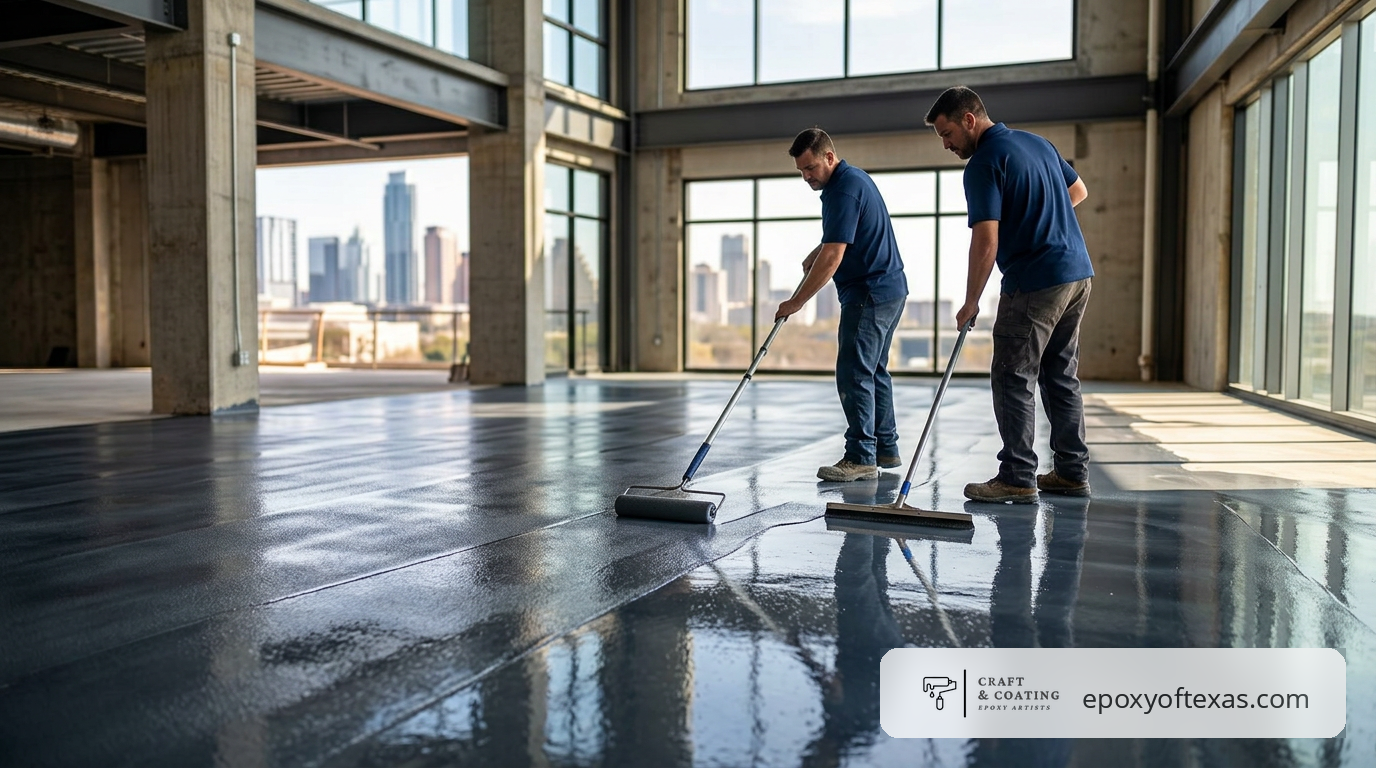
Commercial Epoxy Flooring in Texas: Complete 2026 Guide to Costs, Benefits, and Installation
Quick Answer
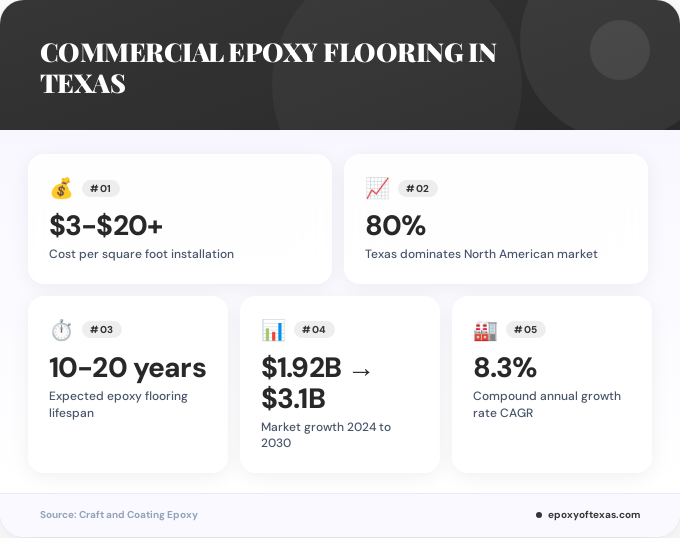
Commercial epoxy flooring in Texas typically costs between $3 to $20+ per square foot depending on project scope, system complexity, and surface preparation needs. With Texas dominating over 80% of the North American epoxy flooring market valued at $1.92 billion in 2024 and projected to reach $3.1 billion by 2030, this durable solution offers 10-20 year lifespans, exceptional chemical resistance, and rapid curing systems perfect for the state’s booming industrial and commercial sectors.
What Is Commercial Epoxy Flooring and Why Is It Ideal for Texas Businesses?
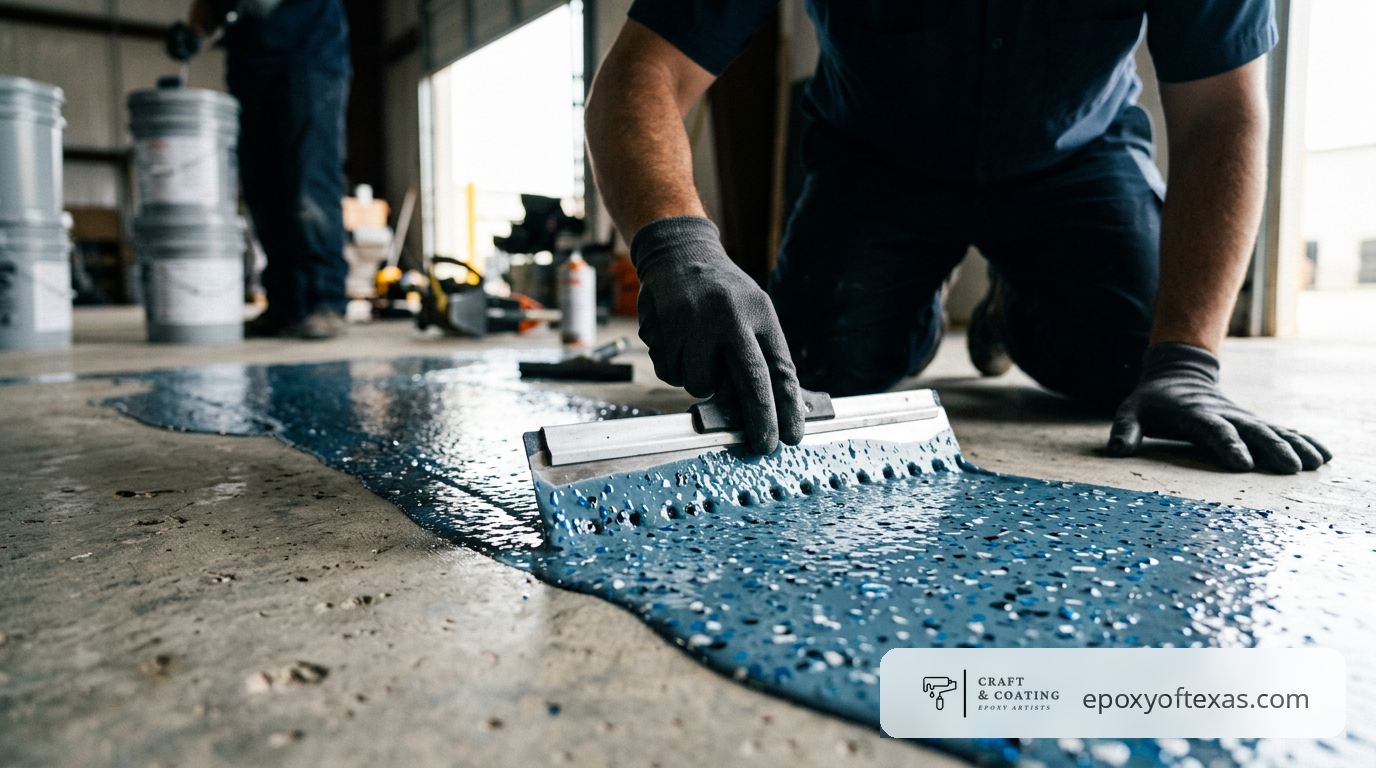
Commercial epoxy flooring represents a high-performance resinous coating system that transforms concrete surfaces into durable, chemical-resistant, and aesthetically pleasing floors. This two-component system combines epoxy resin with a polyamine hardener to create a seamless surface that bonds directly to concrete substrates, delivering exceptional strength and longevity.
For Texas businesses, commercial epoxy flooring offers distinct advantages in the state’s demanding climate. With over 100°F summer temperatures becoming routine across Dallas, Houston, Austin, and San Antonio, epoxy’s thermal stability and UV-resistant formulations make it uniquely suited to withstand the Lone Star State’s extreme weather conditions.
Texas leads the North American epoxy flooring market, which reached $1.92 billion in 2024. The state’s robust industrial sector, including manufacturing, oil and gas, food processing, and rapidly expanding e-commerce warehousing, drives continuous demand for flooring solutions that can handle heavy traffic, chemical exposure, and constant operational demands.
How Is the Texas Epoxy Flooring Market Growing in 2026?
The commercial epoxy flooring market in Texas continues its remarkable expansion trajectory in 2026, fueled by unprecedented industrial investment and construction activity. The North American market, where the U.S. commands over 80% revenue share, is projected to surge from $1.92 billion in 2024 to $3.1 billion by 2030, representing a compound annual growth rate (CAGR) of 8.3%.
Texas specifically benefits from major industrial expansions, including Tyson Foods’ $200 million investment in a 143,000-square-foot facility that requires extensive epoxy flooring for food-grade compliance. In Austin alone, recent data tracked 18 commercial and industrial projects averaging 3,994 square feet each, supported by 90 verified contractors (including 10 minority-owned and 7 women-owned businesses).
The broader industrial floor coating market, of which epoxy maintains a commanding 36% share in 2026 due to superior chemical resistance, reached $6.61 billion globally and projects growth to $8.48 billion by 2030 at a 6.4% CAGR. The U.S. floor coatings market specifically achieved $626.2 million in 2025, with epoxy as the largest segment driving forward at a 7.3% CAGR through 2030.
| Market Segment | 2024 Value | 2030 Projection |
|---|---|---|
| North America Epoxy Flooring | $1.92 billion | $3.1 billion |
| Global Industrial Floor Coatings | $6.61 billion (2026) | $8.48 billion |
| U.S. Floor Coatings | $626.2 million (2025) | 7.3% CAGR growth |
What Factors Determine Commercial Epoxy Flooring Costs in Texas?
Pricing for commercial epoxy flooring in Texas varies significantly based on multiple interconnected factors, with costs typically ranging from $3 to $20+ per square foot. For standard commercial kitchens and light industrial applications, businesses can expect pricing between $8 to $15 per square foot, though premium systems with specialized requirements may command higher investment.
The most critical cost driver is surface preparation, which comprises approximately 60% of total labor expenses. Texas concrete often requires diamond grinding, shot blasting, or acid etching to achieve proper substrate bonding. Older facilities or those with existing coatings may require extensive removal and repair work, significantly impacting project budgets.
System complexity directly influences pricing. Basic single-coat epoxy applications sit at the lower end of the spectrum, while multi-layer systems featuring primer coats, color flakes, metallic effects, or topcoats with enhanced UV or chemical resistance reach premium pricing tiers. Additional considerations include moisture mitigation requirements (moisture testing typically adds $150 to project costs), substrate condition, square footage (larger projects benefit from economies of scale), and facility downtime constraints requiring rapid-cure formulations.
Pricing varies based on your specific project requirements, including surface condition, system selection, and performance specifications. Premium epoxy installations emphasize value and craftsmanship over initial cost, delivering decades of reliable performance that far outweighs budget alternatives. Contact professional contractors for custom quotes tailored to your facility’s unique needs.
What Performance Specifications Should Texas Businesses Expect?
Commercial epoxy flooring systems deliver exceptional performance metrics that justify their investment for Texas businesses. Standard epoxy installations provide 10,000 psi compressive strength, far exceeding the demands of heavy equipment, forklifts, and constant foot traffic common in warehouses and manufacturing facilities.
The hardness rating typically measures between 70-85 Shore D, creating a surface that resists impacts, abrasion, and scratching from daily operations. Standard commercial systems apply at 10-20 mil thickness, though high-performance applications may specify thicker builds for enhanced durability and longevity.
When properly installed and maintained, commercial epoxy flooring in Texas delivers 10-20 year lifespans, even under demanding conditions. This longevity depends critically on UV-stable formulations designed specifically for Texas’ intense solar exposure, particularly for facilities with skylights or large door openings. Similar to how proper facility maintenance systems extend equipment life, regular cleaning and periodic recoating maximize epoxy floor investment returns.
What Are the Latest Commercial Epoxy Flooring Trends in 2026?
The commercial epoxy flooring industry in 2026 emphasizes sustainability, performance innovation, and regulatory compliance. Low-VOC water-based epoxy systems have gained significant market share as Texas businesses pursue EPA compliance and LEED certification, particularly in healthcare, retail, and educational facilities where indoor air quality directly impacts occupant wellbeing.
According to industry trend analysis, antimicrobial epoxy variants now address heightened hygiene standards in food processing, pharmaceutical manufacturing, and healthcare applications. These specialized formulations incorporate antimicrobial agents directly into the resin matrix, providing continuous protection against bacterial growth.
Rapid-cure and self-leveling systems represent critical innovations for businesses unable to sustain extended downtime. These advanced formulations allow facilities to return to operations within hours rather than days, minimizing revenue disruption. Bio-based epoxy resins, currently holding approximately 5% market share, appeal to sustainability-focused corporations seeking to reduce their environmental footprint through renewable raw materials.
| Trend | Key Driver | Texas Relevance |
|---|---|---|
| Low-VOC & Sustainable | EPA/LEED standards, bio-based epoxies | Healthcare, commercial spaces in Austin |
| Antimicrobial & Decorative | Hygiene regulations | Food processing, retail |
| Rapid-Cure Systems | Minimize downtime | Industrial warehouses, e-commerce |
| UV/Heat-Resistant | Extreme climates | Austin summers exceeding 100°F |
Environmental Product Declarations (EPDs) and recycled content now factor prominently in specification decisions, aligning with green building certifications. The industrial flooring market increasingly demands transparency regarding product composition, manufacturing impacts, and lifecycle sustainability.
How Does Texas Climate Impact Epoxy Flooring Performance?
Texas presents unique environmental challenges that demand specialized epoxy formulations. Summer temperatures routinely exceeding 100°F across major metropolitan areas including Houston, Dallas, Fort Worth, and San Antonio require UV-stable epoxy systems that resist yellowing, chalking, and degradation from intense solar radiation.
Temperature fluctuations between scorching summers and occasional winter freezes create expansion and contraction cycles that test flooring system flexibility. High-quality commercial epoxy installations incorporate flexible topcoats and proper joint detailing to accommodate these thermal movements without cracking or delamination.
Humidity variations, particularly in coastal regions near Houston and Corpus Christi, necessitate moisture vapor transmission testing before installation. Texas contractors routinely conduct moisture testing to identify potential bonding issues, adding approximately $150 to project costs but preventing costly failures. Just as proper environmental assessments ensure system integrity in other building systems, moisture evaluation protects epoxy investment.
UV-resistant formulations specifically engineered for Texas conditions incorporate specialized additives that maintain color stability and surface integrity despite relentless sun exposure. These premium systems justify higher initial costs through extended service life and preserved aesthetics that protect property values.
Which Texas Industries Benefit Most from Epoxy Flooring?
Commercial epoxy flooring in Texas serves diverse industries, each leveraging specific performance characteristics. Manufacturing facilities prioritize chemical resistance and impact durability, with epoxy handling oils, solvents, and heavy machinery traffic that would quickly destroy standard concrete or tile surfaces.
The food and beverage sector represents a major growth segment, requiring USDA-compliant antimicrobial epoxy systems that maintain sanitary conditions while withstanding thermal shock from cleaning protocols and aggressive chemical sanitizers. Recent expansions like Tyson Foods’ massive Texas facility demonstrate this sector’s commitment to premium flooring solutions.
E-commerce warehousing and distribution centers, expanding rapidly throughout the Dallas-Fort Worth metroplex and Houston area, demand durable surfaces capable of supporting constant forklift traffic, heavy pallet loads, and 24/7 operations. Rapid-cure epoxy systems minimize installation downtime, allowing facilities to maintain operational schedules.
Healthcare facilities, educational institutions, and retail spaces increasingly specify low-VOC epoxy for aesthetic appeal combined with easy maintenance and superior hygiene. These applications often incorporate decorative elements, metallic effects, or custom color schemes that enhance interior design while delivering commercial-grade performance.
Municipal and public works applications benefit from epoxy’s longevity and low maintenance requirements, reducing lifecycle costs for budget-conscious government entities. Property value appreciation represents another significant driver, with data showing 15-20% faster home sales in Austin markets featuring professional epoxy installations in garages and workshops.
Key Takeaways
- Market Growth: The North American epoxy flooring market, dominated by Texas, grew from $1.92 billion in 2024 toward $3.1 billion by 2030 at 8.3% CAGR, driven by industrial expansion and commercial demand.
- Cost Structure: Commercial epoxy flooring in Texas ranges from $3 to $20+ per square foot, with surface preparation comprising 60% of labor costs and pricing dependent on system complexity, substrate condition, and project scope.
- Performance Durability: Quality epoxy systems deliver 10,000 psi compressive strength, 70-85 Shore D hardness, and 10-20 year lifespans when using UV-stable formulations designed for Texas’ extreme climate conditions.
- Sustainability Trends: Low-VOC water-based systems, antimicrobial variants, rapid-cure formulations, and bio-based resins (5% market share) address environmental compliance, hygiene standards, and operational efficiency.
- Industry Applications: Manufacturing, food processing, e-commerce warehousing, healthcare, retail, and municipal facilities represent primary sectors benefiting from epoxy’s chemical resistance, durability, and low maintenance.
- Climate Considerations: Texas’ 100°F+ summers and humidity variations require UV-resistant, moisture-tested epoxy systems with flexible topcoats to ensure long-term performance and aesthetic preservation.
- Regional Advantage: Austin’s 18 tracked projects averaging 3,994 square feet and 90 verified contractors (including minority and women-owned businesses) demonstrate robust local industry infrastructure supporting commercial installations.
People Also Ask
How long does commercial epoxy flooring last in Texas?
Commercial epoxy flooring in Texas typically lasts 10-20 years when properly installed with UV-stable formulations designed for the state’s extreme climate. Lifespan depends on traffic intensity, maintenance practices, and system quality, with premium installations often exceeding 20 years in controlled environments.
Can epoxy flooring withstand Texas summer heat?
Yes, properly formulated commercial epoxy flooring withstands Texas summer temperatures exceeding 100°F through UV-resistant additives and heat-stable resin systems. These specialized formulations prevent yellowing, chalking, and thermal degradation that would compromise standard epoxy products.
Is epoxy flooring cost-effective for Texas businesses?
Commercial epoxy flooring delivers exceptional cost-effectiveness through 10-20 year lifespans, minimal maintenance requirements, and superior durability compared to tile, vinyl, or polished concrete alternatives. While initial investment ranges from $3 to $20+ per square foot, lifecycle costs prove significantly lower than frequent replacement of cheaper flooring options.
What industries in Texas use epoxy flooring most?
Manufacturing, food and beverage processing, e-commerce warehousing, healthcare facilities, and retail spaces represent the largest commercial epoxy flooring consumers in Texas. These industries prioritize chemical resistance, hygiene compliance, heavy traffic durability, and low maintenance that epoxy systems uniquely provide.
How quickly can commercial epoxy floors be installed in Texas?
Installation timelines vary from 2-7 days for standard systems, though rapid-cure epoxy formulations allow facilities to return to service within 12-24 hours. Project duration depends on surface preparation requirements, square footage, system complexity, and curing conditions, with Texas’ warm climate often accelerating cure times.
Does commercial epoxy flooring require special maintenance in Texas?
Commercial epoxy flooring in Texas requires only routine dust mopping and periodic damp cleaning with pH-neutral cleaners. UV-resistant systems maintain appearance without special treatments, though high-traffic areas may benefit from periodic topcoat reapplication every 5-7 years to preserve optimal performance and aesthetics.
Frequently Asked Questions
What is the typical cost range for commercial epoxy flooring in Texas?+
Commercial epoxy flooring in Texas typically ranges from $3 to $20+ per square foot, with most commercial kitchens and light industrial applications falling between $8-$15 per square foot. Pricing varies based on surface preparation needs (which comprise 60% of labor costs), system complexity, substrate condition, and specialized requirements like rapid curing or antimicrobial properties. Contact professional contractors for custom quotes specific to your facility’s requirements.
How does Texas climate affect epoxy flooring performance?+
Texas’ extreme climate with summer temperatures exceeding 100°F and occasional winter freezes requires specialized UV-stable epoxy formulations that resist yellowing, chalking, and thermal degradation. Proper installations incorporate flexible topcoats to accommodate thermal expansion cycles and moisture vapor testing to prevent bonding failures in humid coastal regions. UV-resistant systems maintain color stability and surface integrity despite intense solar exposure common across Dallas, Houston, Austin, and San Antonio.
What industries benefit most from commercial epoxy flooring in Texas?+
Manufacturing facilities, food and beverage processing plants, e-commerce warehouses, healthcare facilities, retail spaces, and municipal buildings represent the primary beneficiaries of commercial epoxy flooring in Texas. These industries prioritize epoxy’s chemical resistance, antimicrobial properties, heavy traffic durability, and low maintenance requirements. Recent major installations include Tyson Foods’ $200 million, 143,000-square-foot Texas facility requiring extensive food-grade epoxy systems.
How long does commercial epoxy flooring installation take?+
Standard commercial epoxy flooring installations in Texas typically require 2-7 days from surface preparation through final curing, though rapid-cure systems allow facilities to resume operations within 12-24 hours. Timeline depends on project square footage, substrate condition, surface preparation requirements, system complexity, and environmental conditions. Texas’ warm climate often accelerates curing times compared to cooler regions, potentially reducing overall project duration.
What performance specifications should businesses expect from commercial epoxy?+
Commercial epoxy flooring delivers 10,000 psi compressive strength, 70-85 Shore D hardness, and 10-20 mil thickness in standard applications. These systems withstand heavy equipment, forklift traffic, chemical exposure, and thermal shock while maintaining aesthetic appearance. When properly installed with UV-stable formulations designed for Texas conditions, commercial epoxy flooring provides 10-20 year lifespans with minimal maintenance beyond routine cleaning.
Are there sustainable epoxy flooring options available in Texas?+
Yes, sustainable epoxy options include low-VOC water-based systems preferred for EPA and LEED compliance, bio-based resins currently holding 5% market share, and products with Environmental Product Declarations (EPDs) documenting lifecycle impacts. These environmentally responsible formulations particularly benefit healthcare facilities, educational institutions, and corporate spaces in Austin and other Texas markets prioritizing indoor air quality and green building certifications while maintaining commercial-grade performance.
How does epoxy flooring impact Texas commercial property values?+
Professional epoxy flooring installations significantly enhance commercial property values through improved aesthetics, reduced maintenance costs, and extended floor lifespan. Data from Austin markets shows properties with quality epoxy installations sell 15-20% faster than comparable properties with standard concrete or deteriorated flooring. The investment in premium epoxy systems typically returns multiples through reduced replacement cycles, lower cleaning costs, and enhanced facility presentation that attracts quality tenants and buyers.