Industrial Floor Coating in Austin: Complete 2026 Guide to Costs, Solutions, and Market Insights
Quick Answer
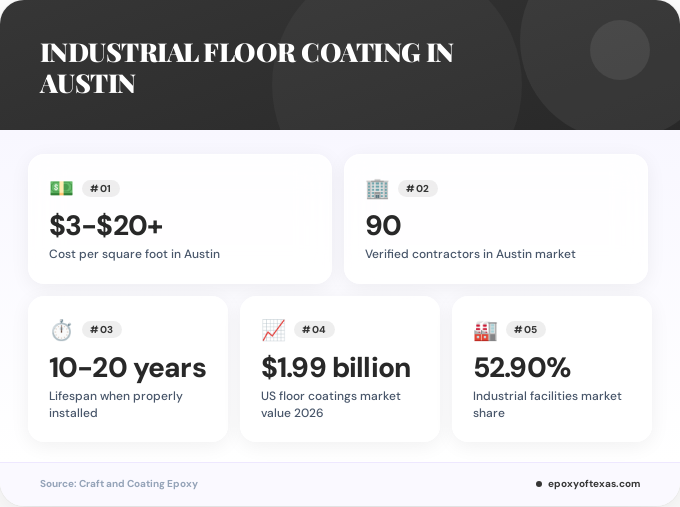
Industrial floor coating in Austin ranges from $3 to $20+ per square foot, with epoxy systems dominating the market for warehouses, manufacturing facilities, and data centers. The Austin market features 90 verified contractors handling projects averaging 3,994 square feet, with solutions lasting 10 to 20 years when properly installed with UV and heat-resistant formulations suited to Texas climate conditions.
What Is Industrial Floor Coating and Why Does Austin Need It?
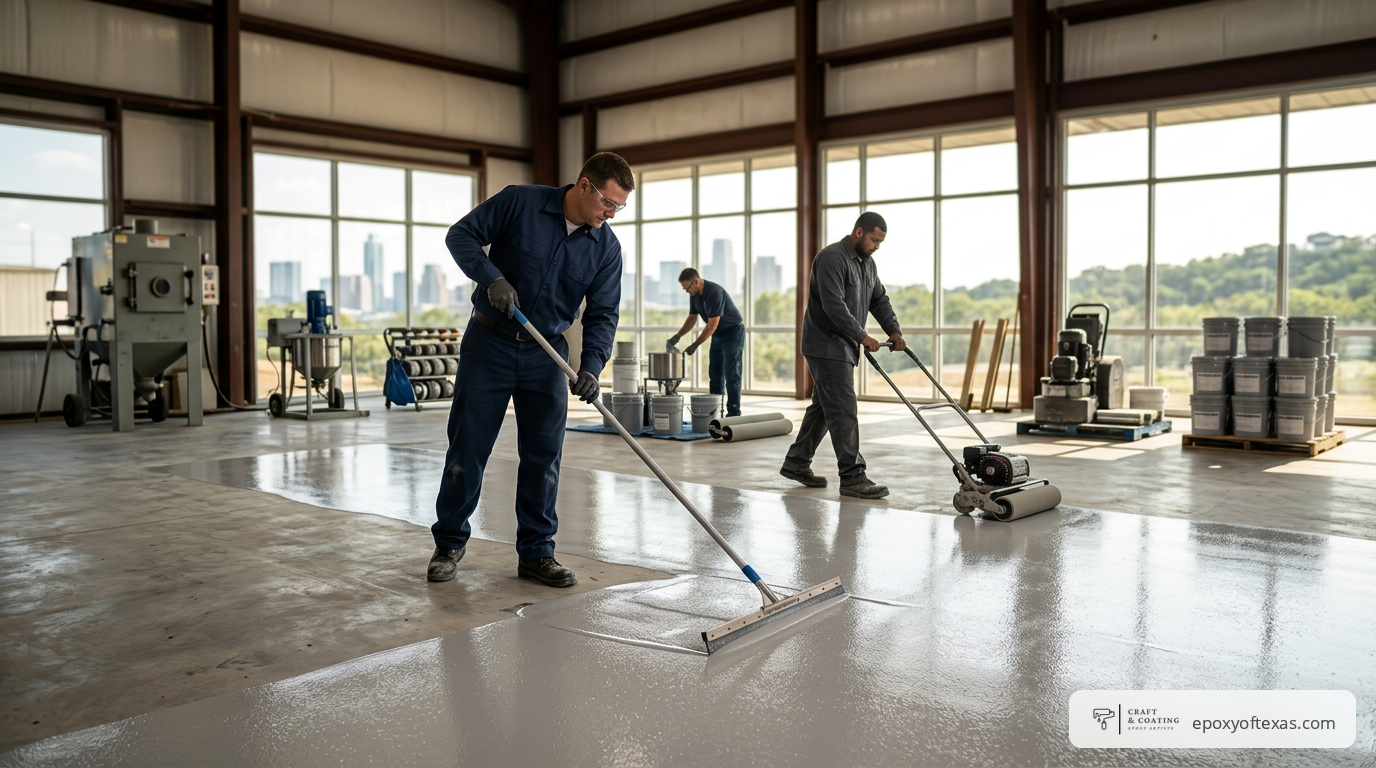
Industrial floor coating in Austin represents specialized surface protection systems engineered to withstand heavy machinery, chemical exposure, thermal stress, and continuous traffic in manufacturing, warehouse, and commercial facilities. Unlike standard flooring, these high-performance coatings create seamless, durable surfaces that enhance safety, hygiene, and operational efficiency.
Austin’s industrial sector is experiencing unprecedented growth in 2026, with $40 billion in Texas construction projects driving demand for robust flooring solutions. The city’s expanding data center corridor, advanced manufacturing facilities, and logistics hubs require surfaces that can handle forklift traffic, resist oil and chemical spills, and maintain performance in temperatures exceeding 100°F during Texas summers.
The commercial epoxy flooring market in Texas reflects this demand, with industrial facilities capturing 52.90% of the US floor coatings market share as of 2025. Austin’s unique combination of tech sector growth, manufacturing expansion, and aging industrial infrastructure creates perfect conditions for flooring upgrades that boost property value while improving workplace safety.
How Is the Industrial Floor Coating Market Growing in 2026?
The global industrial floor coating market reached approximately $6.6 to $6.71 billion in 2026, according to multiple market intelligence reports. Projections indicate sustained growth to $8.48 billion by 2030 at a compound annual growth rate (CAGR) of 6.4%, with some analysts forecasting expansion to $12.3 billion by 2035 at a 7.2% CAGR.
In the United States specifically, the floor coatings market stands at $1.99 billion in 2026, expanding at a 4.12% CAGR to reach $2.43 billion by 2031. Industrial facilities dominate this landscape, maintaining their majority market share through consistent demand from manufacturing, warehousing, and logistics sectors.
| Market Segment | 2026 Value | Growth Rate |
|---|---|---|
| Global Industrial Coatings | $6.6-6.71 billion | 6.4-7.2% CAGR |
| US Floor Coatings Market | $1.99 billion | 4.12% CAGR |
| Epoxy Flooring Global | $662 million (2025) | 9.3% CAGR |
The epoxy segment, which dominates Austin’s industrial installations, demonstrates particularly strong momentum with the global epoxy flooring market growing from $662 million in 2025 to a projected $1,110 million by 2031 at a 9.3% CAGR. This outpaces general industrial coating growth, reflecting epoxy’s superior chemical resistance, durability, and cost-effectiveness for high-traffic applications.
What Types of Industrial Floor Coatings Work Best in Austin?
Austin industrial facilities typically deploy four primary coating systems, each engineered for specific performance requirements and operational environments. Understanding these options helps facility managers match solutions to their unique demands.
Epoxy coatings represent the most popular choice in Austin, accounting for the majority of industrial installations. These thermosetting resins create rock-hard surfaces resistant to chemicals, abrasion, and impact. Standard epoxy systems last 10 to 20 years in Austin’s climate when properly formulated with UV-stable compounds and heat-resistant properties. The epoxy flooring specialists in Austin report projects averaging 3,994 square feet across 18 tracked installations.
Polyurethane coatings offer exceptional flexibility and scratch resistance, making them ideal for facilities with thermal expansion concerns or areas requiring softer surfaces. While representing a smaller market share than epoxy, polyurethane demonstrates the fastest growth rate among coating types, particularly in food processing and pharmaceutical applications where hygiene standards demand smooth, non-porous surfaces.
Polyaspartic coatings have gained traction in Austin’s tight labor market due to their rapid curing times. These advanced systems can be installed and returned to service within 24 hours, minimizing costly production downtime. The Southwest Austin commercial flooring contractors increasingly recommend polyaspartic for facilities that cannot afford extended shutdowns, despite premium pricing 15 to 30% above standard epoxy systems.
Methyl methacrylate (MMA) coatings solve Austin’s extreme temperature challenges, curing effectively in conditions from -20°F to 120°F. These fast-setting systems work exceptionally well in outdoor loading docks, unconditioned warehouses, and facilities requiring 24/7 operations. MMA’s cold-weather capabilities also enable winter installations without heated enclosures.
How Much Does Industrial Floor Coating Cost in Austin?
Industrial floor coating costs in Austin span a wide spectrum, typically ranging from $3 to $20+ per square foot, depending on substrate condition, coating system complexity, square footage, and performance specifications. This pricing variability reflects the dramatic differences between basic single-coat epoxy applications and advanced multi-layer systems with specialized additives.
Several critical factors influence final project costs. Surface preparation often represents 30 to 50% of total expenses, as industrial concrete requires shot blasting, diamond grinding, or scarifying to achieve proper profile for coating adhesion. Facilities with damaged slabs, oil contamination, or failing existing coatings face substantially higher prep costs.
Coating system thickness and layers directly impact pricing. Basic 10 to 15 mil epoxy systems fall at the lower end of the cost spectrum, while heavy-duty 125 to 250 mil systems with base coat, build coat, and topcoat layers command premium pricing. These thicker systems provide superior impact resistance and longevity for facilities with forklift traffic and heavy equipment.
Specialty additives and features substantially increase costs but deliver critical functionality. Electrostatic dissipative (ESD) coatings for electronics manufacturing, antimicrobial additives for food processing, and chemical-resistant topcoats for pharmaceutical facilities add $2 to $8 per square foot beyond base system costs. The comprehensive Texas epoxy floor pricing guide details how these performance enhancements affect total investment.
Project scale and complexity create significant pricing variations. Large open warehouse floors (20,000+ square feet) achieve economies of scale, potentially reaching the lower end of the cost spectrum. Conversely, multi-room facilities with corners, drains, and equipment footprints require more labor and material handling, pushing costs higher. Austin facilities should budget an additional 15 to 25% for projects requiring night or weekend installation to maintain operations.
Which Austin Industries Benefit Most from Floor Coatings?
Austin’s diverse industrial landscape creates demand across multiple sectors, each with unique flooring requirements. Understanding industry-specific needs helps facility managers specify appropriate coating systems.
Manufacturing facilities represent the largest user segment, requiring floors that withstand continuous machinery vibration, chemical spills, and thermal stress. Austin’s growing advanced manufacturing sector, including semiconductor, automotive, and aerospace components, demands coatings meeting strict cleanliness standards. Electronics manufacturers particularly benefit from ESD-protective coatings that prevent static discharge damage to sensitive components.
Warehouse and logistics operations dominate Austin’s industrial real estate market, with thousands of square feet of new distribution space coming online in 2026. These facilities need highly abrasion-resistant coatings to handle constant forklift traffic, pallet movement, and loading dock operations. The city’s position as a major distribution hub for companies serving Texas and Southwest markets drives sustained demand for durable warehouse flooring.
Food processing and beverage production facilities require specialized coatings meeting FDA and USDA sanitation standards. These antimicrobial systems create seamless, non-porous surfaces that resist bacterial growth and facilitate thorough cleaning. Austin’s craft beverage industry and food manufacturing sector prioritize coatings with excellent resistance to oils, acids, and thermal shock from frequent washdowns.
Data centers and technology facilities constitute a rapidly growing segment in Austin’s 2026 construction pipeline. These critical infrastructure projects require specialized conductive flooring that protects sensitive equipment while managing electrostatic discharge. Clean room requirements demand ultra-smooth surfaces that minimize particle generation and facilitate stringent contamination control protocols.
Automotive service and equipment maintenance facilities benefit from chemical-resistant coatings that handle oils, solvents, hydraulic fluids, and battery acids. Austin’s extensive fleet maintenance operations, including municipal vehicle facilities and commercial trucking centers, specify epoxy systems engineered for automotive environments.
What Are the Top Industrial Flooring Trends in 2026?
The industrial floor coating landscape in Austin continues evolving in 2026, driven by technological advancement, regulatory requirements, and changing operational priorities. Several key trends shape current specification decisions.
Sustainable, low-VOC formulations dominate new installations as Austin facilities respond to increasingly stringent environmental regulations and corporate sustainability commitments. Modern coating systems achieve less than 50 grams per liter VOC content while maintaining or exceeding performance of traditional formulations. This regulatory push creates +0.8% market impact according to industry analyses, particularly in occupied facilities where air quality concerns affect worker health.
Rapid-cure polyaspartic systems address Austin’s construction labor constraints, with 4.7% employment growth through 2033 creating capacity challenges. These fast-setting coatings enable installation and return-to-service within 24 hours, minimizing production downtime that can cost facilities thousands of dollars per hour. The professional installation teams in Austin increasingly recommend polyaspartic for time-sensitive projects despite premium pricing.
Growth Rate: 4.42% CAGR to 2031
Primary Use: Warehouses, Manufacturing
Regulation: EPA Compliance Push
Applications: Urban Austin Buildings
Industries: Pharma, Electronics, Food
Premium: $2-8/sq ft Additional
Polyurethane: Fastest Growing
Austin Average: 3,994 sq ft Projects
Specialized performance features continue expanding beyond basic protection. Antimicrobial coatings for healthcare and food processing, conductive flooring for electronics manufacturing, and chemical-resistant systems for pharmaceutical operations represent high-growth niches. Healthcare projects capture 27% of specialty coating installations, driven by stringent infection control requirements.
Decorative industrial finishes blur traditional lines between functional and aesthetic flooring. Austin’s tech campus expansions and modern manufacturing facilities increasingly specify metallic epoxy systems, colored quartz broadcasts, and polished concrete overlays that create professional appearances while delivering industrial durability. This trend extends the residential epoxy design concepts into commercial environments.
Smart coating technologies emerge as data-driven facilities seek embedded sensors and condition-monitoring capabilities. While still nascent, these systems integrate temperature sensors, moisture detection, and wear indicators directly into floor coatings, enabling predictive maintenance and real-time performance monitoring.
How Does Austin’s Climate Affect Floor Coating Performance?
Austin’s unique climate presents specific challenges that directly impact industrial floor coating selection and longevity. Understanding these environmental factors proves essential for maximizing coating performance and return on investment.
Extreme temperature fluctuations characterize Austin’s weather, with summer temperatures exceeding 100°F and winter lows occasionally dropping below freezing. This thermal cycling creates expansion and contraction stress in concrete slabs and coating systems. Properly engineered coatings must accommodate these movements without cracking or delaminating. Heat-resistant formulations specifically designed for Texas conditions maintain adhesion and performance throughout seasonal extremes.
Intense UV exposure affects facilities with skylights, large windows, or outdoor loading areas. Standard epoxy formulations can yellow and chalk under prolonged UV radiation, degrading both appearance and surface integrity. UV-stable coatings incorporating aliphatic polyurethane or polyaspartic topcoats maintain color stability and gloss retention despite Austin’s intense sunshine.
High humidity and moisture vapor transmission create adhesion challenges, particularly in older facilities without proper moisture barriers. Austin’s subtropical humidity levels require thorough moisture testing before coating installation. Systems must either block moisture transmission through epoxy moisture barriers or accommodate vapor movement through breathable coatings. Failure to address moisture issues leads to coating delamination and costly repairs.
The longevity of epoxy floors in Austin depends heavily on proper climate-appropriate specification. Well-designed systems incorporating UV inhibitors, heat-resistant resins, and appropriate thickness achieve their full 10 to 20-year service life, while improperly specified coatings may fail within 3 to 5 years.
How Do You Select the Right Industrial Floor Coating?
Selecting optimal industrial floor coating systems requires systematic evaluation of multiple factors specific to your Austin facility. This decision-making framework helps prioritize critical requirements.
Assess operational demands by documenting traffic patterns, equipment loads, chemical exposures, and cleaning protocols. Facilities with continuous forklift operations require thicker, more impact-resistant systems than light manufacturing areas. Chemical resistance specifications must match actual substances encountered, as coatings resistant to petroleum products may fail under acidic or alkaline exposures.
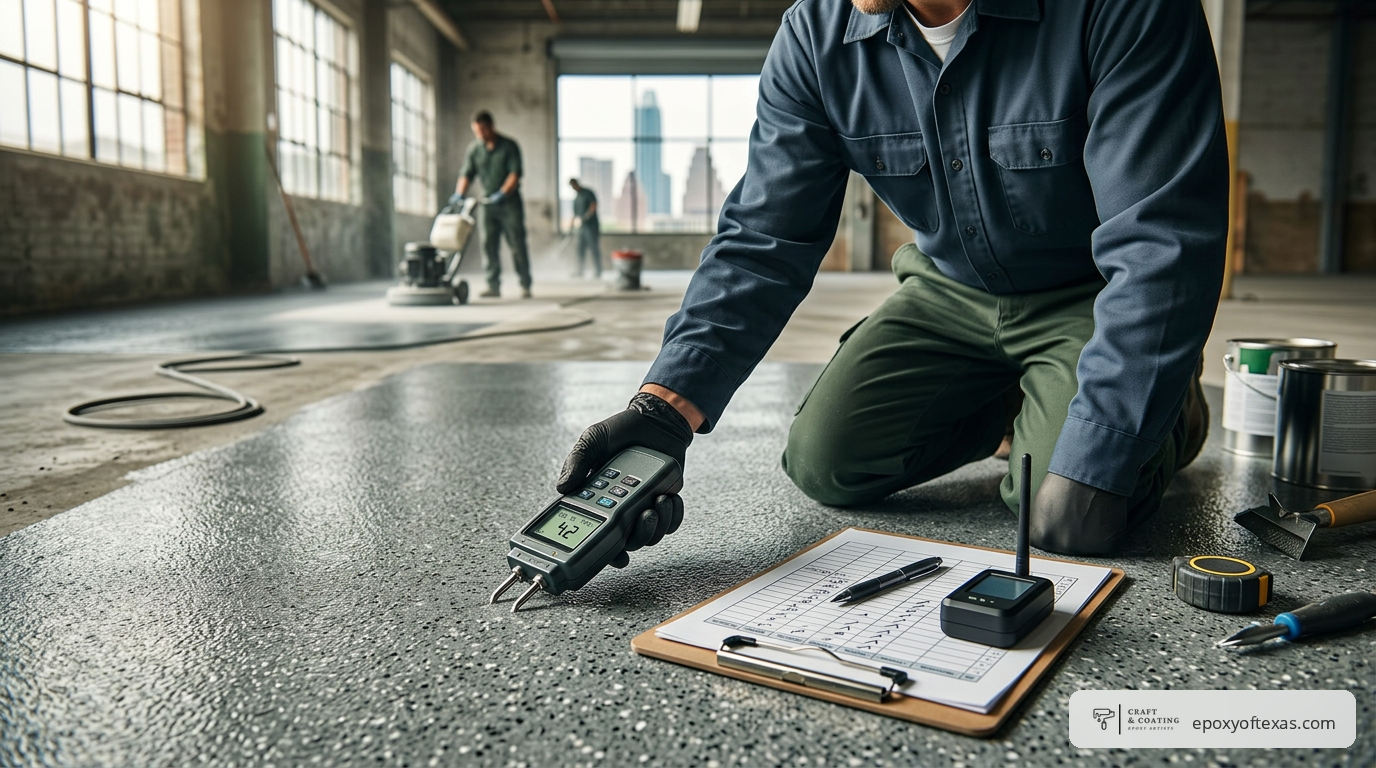
Evaluate substrate conditions through comprehensive testing. This includes concrete strength testing, moisture vapor emission measurement, and surface profile assessment. Older Austin industrial buildings may present concrete carbonation, existing coating contamination, or structural cracks requiring remediation before coating application. The qualified contractors in Austin provide thorough pre-installation assessments identifying potential issues.
Consider installation timing and downtime tolerance when choosing coating systems. Standard epoxy requires 3 to 7 days from surface preparation through final cure and return to service. Fast-cure polyaspartic systems reduce this window to 24 to 48 hours. Facilities operating multiple shifts may require phased installations or premium rapid-cure systems despite higher costs.
Factor long-term maintenance requirements into coating selection. Some systems require periodic recoating every 5 to 7 years, while premium formulations may last 15 to 20 years with only routine cleaning. Calculate total cost of ownership including maintenance labor, production downtime, and eventual replacement when comparing systems.
Verify contractor qualifications and references before finalizing decisions. The 90 verified epoxy flooring contractors in Austin vary significantly in expertise, with 10 minority-owned and 7 women-owned businesses offering diverse capabilities. Request documentation of similar project experience, manufacturer certifications, and insurance coverage appropriate for industrial installations.
Key Takeaways
- Market growth positions industrial floor coatings as a $6.6 to $6.71 billion global market in 2026, with US facilities commanding 52.90% market share and driving sustained 4.12 to 4.42% annual growth through 2031.
- Cost considerations span $3 to $20+ per square foot in Austin, heavily influenced by surface preparation requirements, coating system complexity, and specialized performance features like antimicrobial or ESD properties.
- Epoxy dominance continues in Austin installations, with projects averaging 3,994 square feet and systems engineered for 10 to 20-year lifespans when properly specified for Texas climate conditions.
- Climate adaptation requires UV-stable, heat-resistant formulations capable of withstanding Austin’s extreme temperature fluctuations, intense sunshine, and subtropical humidity without performance degradation.
- Industry applications vary dramatically, from warehouse and logistics facilities requiring abrasion resistance to pharmaceutical and food processing operations demanding antimicrobial, FDA-compliant surfaces.
- Emerging trends include rapid-cure polyaspartic systems addressing labor constraints, low-VOC sustainable formulations meeting environmental regulations, and smart coating technologies enabling condition monitoring.
- Contractor selection proves critical, with 90 verified Austin specialists offering varying expertise levels. Thorough vetting of qualifications, references, and manufacturer certifications ensures successful project outcomes.
People Also Ask
How long do industrial floor coatings last in Austin’s heat?
Industrial floor coatings properly formulated for Austin’s climate typically last 10 to 20 years. Systems incorporating UV-stable compounds and heat-resistant resins maintain performance despite summer temperatures exceeding 100°F. Longevity depends on coating thickness, traffic levels, and maintenance practices.
What’s the difference between epoxy and polyaspartic for industrial floors?
Epoxy offers superior chemical resistance and impact strength at lower costs, with curing times of 3 to 7 days. Polyaspartic systems cure in 24 hours, enabling faster return to service, but typically cost 15 to 30% more. Both perform well in Austin’s climate when properly specified for temperature extremes and UV exposure.
Can industrial floor coatings be applied over existing coatings?
Application over existing coatings depends on the current system’s condition and adhesion. Properly bonded existing coatings can sometimes be abraded and overcoated, reducing preparation costs. However, failing, contaminated, or incompatible coatings must be completely removed to ensure new system adhesion and performance.
What industries require specialized antimicrobial floor coatings?
Food processing, pharmaceutical manufacturing, healthcare facilities, and commercial kitchens require antimicrobial coatings meeting FDA and USDA standards. These systems incorporate additives that inhibit bacterial growth and create seamless surfaces facilitating thorough sanitation. Austin’s growing biopharmaceutical sector particularly demands these specialized flooring solutions.
How does concrete age affect industrial coating installation?
New concrete requires minimum 28-day curing before coating application to achieve adequate strength and moisture stabilization. Older concrete may present carbonation, contamination, or structural issues requiring remediation. Pre-installation testing determines concrete suitability and identifies necessary preparation work for successful coating adhesion.
What maintenance do industrial floor coatings require?
Regular maintenance includes daily sweeping or dust mopping, periodic cleaning with pH-neutral detergents, and immediate spill cleanup. High-traffic areas may require annual abrasion protection recoating. Proper maintenance extends coating lifespan significantly, with well-maintained systems achieving 15 to 20 years in Austin facilities.
Frequently Asked Questions
How much does industrial epoxy flooring cost per square foot in Austin?+
Industrial epoxy flooring in Austin ranges from $3 to $20+ per square foot, depending on surface preparation needs, coating system thickness, and specialized features. Basic single-coat systems fall at the lower end, while heavy-duty multi-layer installations with chemical resistance or ESD properties command premium pricing. Project scale, substrate condition, and installation timing significantly impact final costs.
What’s the best floor coating for Austin warehouses?+
Heavy-duty epoxy systems in 125 to 250 mil thickness perform best for Austin warehouse applications with forklift traffic and continuous operations. These multi-layer systems incorporate base coat, build coat, and abrasion-resistant topcoat for maximum durability. UV-stable formulations prevent yellowing in facilities with natural lighting, while heat-resistant resins accommodate temperature extremes.
How long does industrial floor coating installation take?+
Standard epoxy installations require 3 to 7 days from surface preparation through final cure and return to service. This includes concrete grinding or shot blasting, base coat application, optional decorative layers, topcoat installation, and full cure time. Rapid-cure polyaspartic systems reduce this timeline to 24 to 48 hours, making them ideal for facilities requiring minimal downtime.
Can industrial floor coatings handle chemical spills?+
Properly specified industrial coatings provide excellent chemical resistance when matched to specific exposures. Epoxy systems handle most petroleum products, mild acids, and alkalines effectively. Facilities with aggressive chemicals require specialized formulations with enhanced chemical-resistant topcoats. Always verify coating compatibility with actual substances used in your operations through chemical resistance charts or manufacturer consultation.
Do industrial floor coatings require special maintenance?+
Industrial coatings require relatively simple maintenance including daily dust mopping, periodic cleaning with pH-neutral detergents, and immediate spill cleanup. Avoid harsh solvents and abrasive scrubbing that can damage coating surfaces. High-traffic areas benefit from annual inspection and touch-up recoating to maintain protection. Proper maintenance extends coating lifespan from typical 10 years to 15 to 20 years in Austin facilities.
What certifications should Austin industrial flooring contractors have?+
Quality contractors maintain manufacturer certifications from major coating suppliers, demonstrating training in proper installation techniques. Look for general liability insurance (minimum $2 million), workers’ compensation coverage, and Texas contractor licensing where applicable. Experience with similar industrial applications, references from comparable facilities, and documented safety programs indicate professional capabilities essential for complex industrial installations.
How do I know if my facility needs ESD flooring?+
Facilities manufacturing or handling electronics, semiconductors, medical devices, or sensitive instrumentation typically require electrostatic dissipative (ESD) flooring. These specialized coatings safely dissipate static charges that could damage components or create safety hazards. Austin’s growing tech sector and data center market increasingly specify ESD systems. Consult with industrial hygiene specialists or coating experts to determine if your operations require ESD protection.