
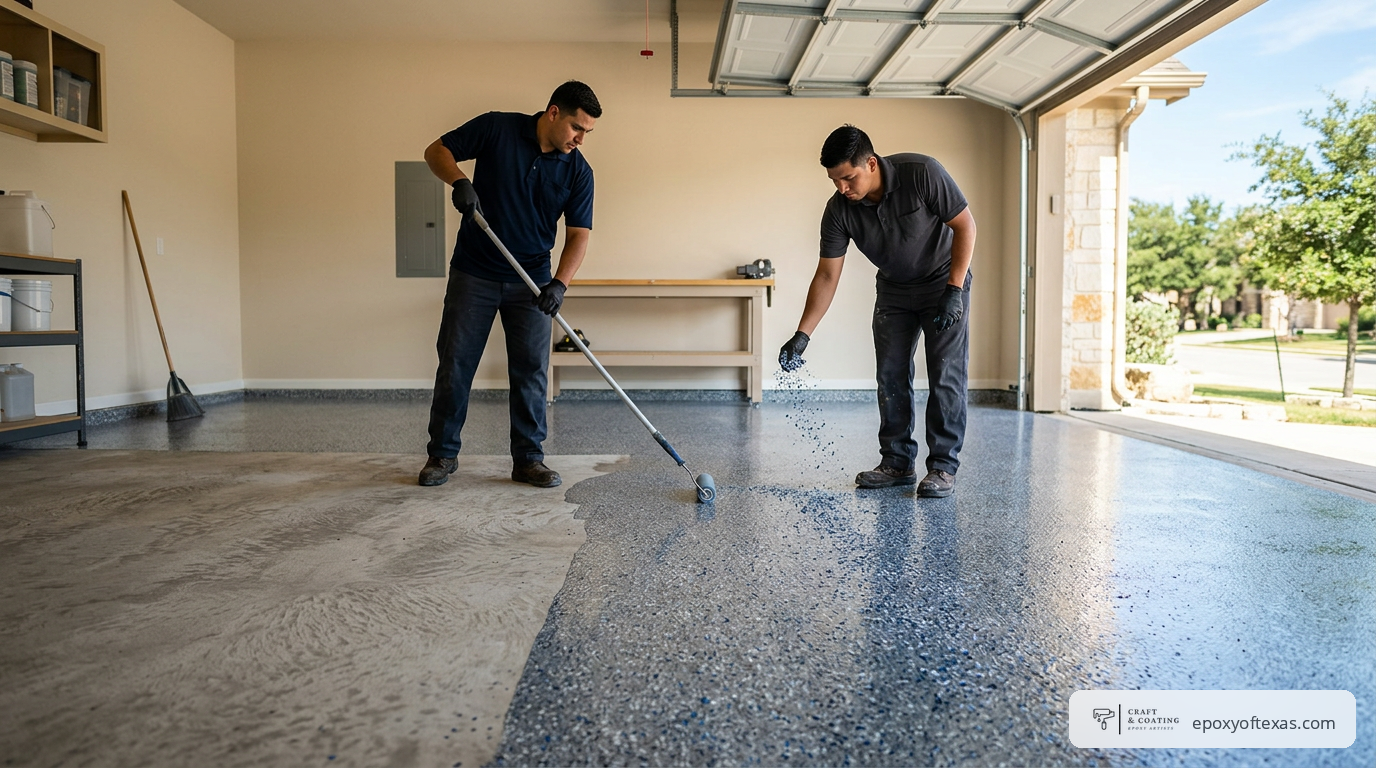
Residential Epoxy Flooring in Texas: Complete 2026 Guide to Costs, Benefits, and Installation
Quick Answer
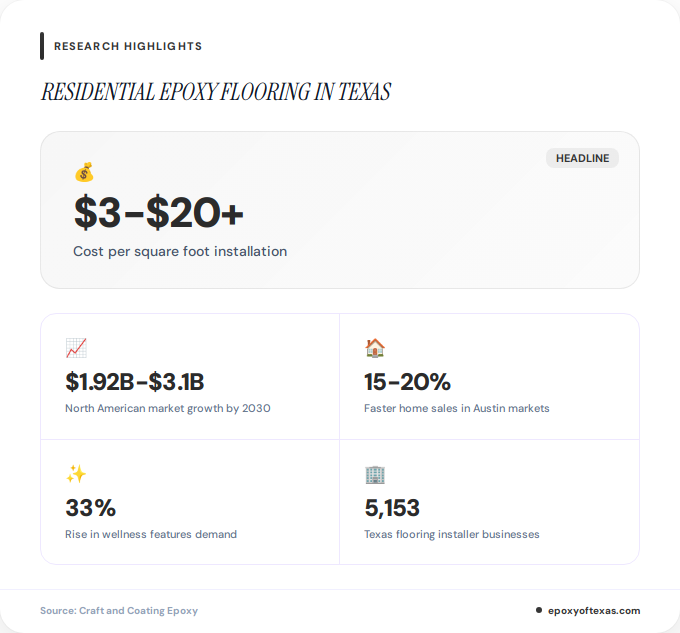
Residential epoxy flooring in Texas costs between $3 to $20+ per square foot depending on application type, with the market projected to grow from $1.92 billion to $3.1 billion across North America by 2030. Texas homeowners are increasingly choosing epoxy for garages, kitchens, and basements due to its durability in the state’s variable climate, with homes featuring epoxy garage floors selling 15-20% faster in competitive markets like Austin.
Texas homeowners are transforming their living spaces with a flooring solution that combines durability, aesthetics, and long-term value. With the North American epoxy flooring market projected to reach $3.1 billion by 2030, growing at an 8.3% annual rate, residential applications are driving significant portions of this expansion across the Lone Star State.
From the humidity of Houston to the intense sun of San Antonio, and from Dallas’s freeze-thaw cycles to Austin’s rapid real estate growth, residential epoxy flooring in Texas is proving to be more than a trend. It is becoming a strategic home improvement investment that addresses the unique challenges of Texas living while delivering measurable returns in both property value and daily functionality.
What Is Residential Epoxy Flooring and Why Is It Gaining Popularity in Texas?
Residential epoxy flooring consists of multiple layers of epoxy resin applied over concrete surfaces to create a durable, seamless, and chemically bonded coating. Unlike traditional paint or sealers that simply sit on top of concrete, epoxy penetrates and bonds at a molecular level, creating a surface that can withstand significant wear, chemical exposure, and temperature fluctuations common throughout Texas.
The popularity surge stems from several converging factors. Texas homeowners are prioritizing materials that deliver lasting value, with wellness features in home listings up 33% as buyers seek durable, low-maintenance solutions. Epoxy flooring supports this trend by eliminating the porous nature of bare concrete, preventing moisture accumulation, dust generation, and microbial growth that can affect indoor air quality.
Additionally, the rise of modern, industrial-inspired interior design has made epoxy’s sleek appearance highly desirable. What once was relegated to commercial garages and warehouses now graces upscale residential kitchens, living areas, and recreational spaces across Texas communities.
How Is the Texas Residential Epoxy Flooring Market Growing in 2026?
The residential epoxy flooring market in Texas is experiencing exponential growth as part of a broader North American surge. The global epoxy flooring market reached $4.8 billion in 2024 and is projected to grow at a 6.4% CAGR, reaching $8.4 billion by 2033. Within North America specifically, the market is expanding from $1.92 billion in 2024 to $3.1 billion by 2030.
Texas is uniquely positioned as a major growth hub within this expansion. The state’s semiconductor and EV-battery megaprojects are driving demand for specialized epoxy systems, creating a ripple effect that benefits residential applications through improved product availability, competitive pricing, and contractor expertise development.
The broader flooring installers industry in Texas comprises 5,153 businesses and has been growing at an average annual rate of 1.4% from 2021 to 2026. This growth reflects sustained construction activity, population migration to Texas metropolitan areas, and increasing homeowner investment in property improvements.
What Does Residential Epoxy Flooring Cost in Texas?
Pricing for residential epoxy flooring in Texas varies significantly based on application complexity, material quality, surface preparation requirements, and project scope. Understanding these variables helps homeowners make informed decisions aligned with their specific needs and budget.
| Application Type | Price Range (per sq ft) | Typical Lifespan |
|---|---|---|
| Basic Coating | $3 to $5 | 5 to 8 years |
| Standard Residential | $8 to $12 | 10 to 15 years |
| Premium/Industrial Grade | $15 to $20+ | 15 to 20+ years |
For context, recent project data in Austin reveals that tracked epoxy flooring projects averaged 3,994 square feet each. At standard residential pricing, homeowners can expect total project costs ranging from $31,950 to $47,930 for projects of this scale. However, pricing varies significantly based on your specific project requirements, surface condition, design complexity, and material selection.
Premium installations that include decorative elements like metallic finishes, custom color blends, or intricate patterns can exceed these ranges substantially. Conversely, smaller projects like single-car garages or laundry rooms may fall below typical minimums but still benefit from volume pricing efficiencies.
For detailed pricing information specific to your project, consider reviewing our comprehensive Epoxy Floor Cost in Texas: Complete 2026 Pricing Guide which breaks down cost factors across different applications.
Where Can You Install Epoxy Flooring in Texas Homes?
While garage floors remain the primary residential application, Texas homeowners are expanding epoxy adoption throughout their homes. Each application leverages epoxy’s unique properties to address specific functional and aesthetic needs.
Garage Floors
Garage flooring represents the most common residential epoxy application, driven by homeowners seeking durable, easy-to-clean surfaces that resist oil stains, tire marks, and chemical spills. Texas garages face unique challenges including intense summer heat that can reach surface temperatures exceeding 140°F, making proper epoxy formulation critical for long-term performance.
Our detailed Complete Guide to Garage Floor Epoxy Near Me in Austin provides location-specific insights for optimizing garage floor installations.
Kitchen and Living Areas
Increasingly, Texas homeowners are adopting epoxy in kitchens, living rooms, and dining areas where the material’s seamless appearance complements modern design aesthetics. Epoxy provides built-in moisture mitigation and slip-resistant textures that make it practical for high-traffic interior spaces while eliminating grout lines that trap dirt and bacteria.
Basements and Below-Grade Spaces
In homes with basements, particularly in North Texas regions, epoxy provides crucial moisture barrier protection. The coating prevents water vapor transmission from concrete slabs, reducing humidity issues and creating healthier indoor environments. This application is especially valuable in areas prone to seasonal flooding or high water tables.
Outdoor Patios and Pool Decks
Texas homeowners are extending their living spaces outdoors with epoxy-coated patios and pool decks. Specialized UV-resistant formulations withstand intense Texas sun exposure while providing slip-resistant surfaces essential for wet environments. These applications must be properly engineered to handle temperature extremes that can range from below freezing to well over 100°F.
Why Is Epoxy Flooring Ideal for Texas Climate Conditions?
Texas presents unique climate challenges that make properly installed epoxy flooring particularly valuable. The state’s variable weather patterns, intense UV exposure, humidity fluctuations, and temperature extremes demand flooring solutions engineered for resilience.
During summer months, concrete surfaces in direct sunlight can reach temperatures exceeding 140°F, causing thermal expansion that would crack or delaminate inferior coatings. High-quality epoxy systems formulated for Texas conditions maintain their bond integrity and flexibility across these temperature ranges.
The state’s humidity variations, from the moisture-heavy Gulf Coast to the arid West Texas plains, create condensation issues on bare concrete surfaces. Epoxy’s moisture-resistant barrier prevents water vapor transmission, eliminating the dampness and musty odors common in untreated garage and basement spaces.
For insights into how climate affects epoxy longevity, refer to our article on How Long Does Epoxy Floor Last in Austin: Complete 2026 Lifespan Guide.
What Makes Austin’s Residential Epoxy Market Unique?
Austin represents a concentrated and sophisticated market for residential epoxy flooring within Texas. The city hosts 90 verified epoxy flooring contractors, including 10 minority-owned and 7 women-owned businesses, reflecting a diverse and competitive service landscape.
Austin contractors command 15-20% labor premiums over state averages due to competitive demand and skilled labor shortages driven by the city’s rapid population growth and construction boom. This premium reflects not just market conditions but also the specialized expertise required to deliver installations that meet Austin homeowners’ high expectations.
Real estate performance metrics demonstrate tangible value: homes with epoxy garage floors sell 15-20% faster in Austin’s competitive market. This acceleration reflects buyer preferences for move-in-ready homes with durable, low-maintenance features that reduce immediate renovation needs.
Austin’s unique position as a technology hub with significant population in-migration creates sustained demand for home improvements that blend functionality with modern aesthetics. The city’s younger demographic and high concentration of design-conscious homeowners drive adoption of premium epoxy finishes including metallic effects, custom color palettes, and artistic patterns.
For contractor selection guidance specific to the Austin market, review our Epoxy Flooring Contractors in Austin: 2026 Complete Guide.
How Does Professional Epoxy Installation Work?
Professional epoxy installation follows a systematic process that ensures proper adhesion, longevity, and appearance. Understanding these steps helps homeowners recognize quality workmanship and set realistic expectations for project timelines.
Surface preparation constitutes the most critical phase, typically consuming 50-60% of total project time. Contractors use diamond grinding equipment to open concrete pores, remove existing coatings or contaminants, and create the proper surface profile for epoxy adhesion. This step cannot be rushed or compromised without risking premature failure.
Crack and void repair follows preparation, with contractors filling imperfections using compatible repair materials. Texas homes often experience foundation settlement that creates hairline cracks requiring professional assessment to determine whether they indicate structural issues or simple cosmetic concerns.
Primer application creates the chemical bridge between concrete and epoxy topcoats. High-quality primers penetrate deeply into concrete, creating molecular bonds that prevent delamination. In moisture-prone areas, specialized moisture-blocking primers add an additional protection layer.
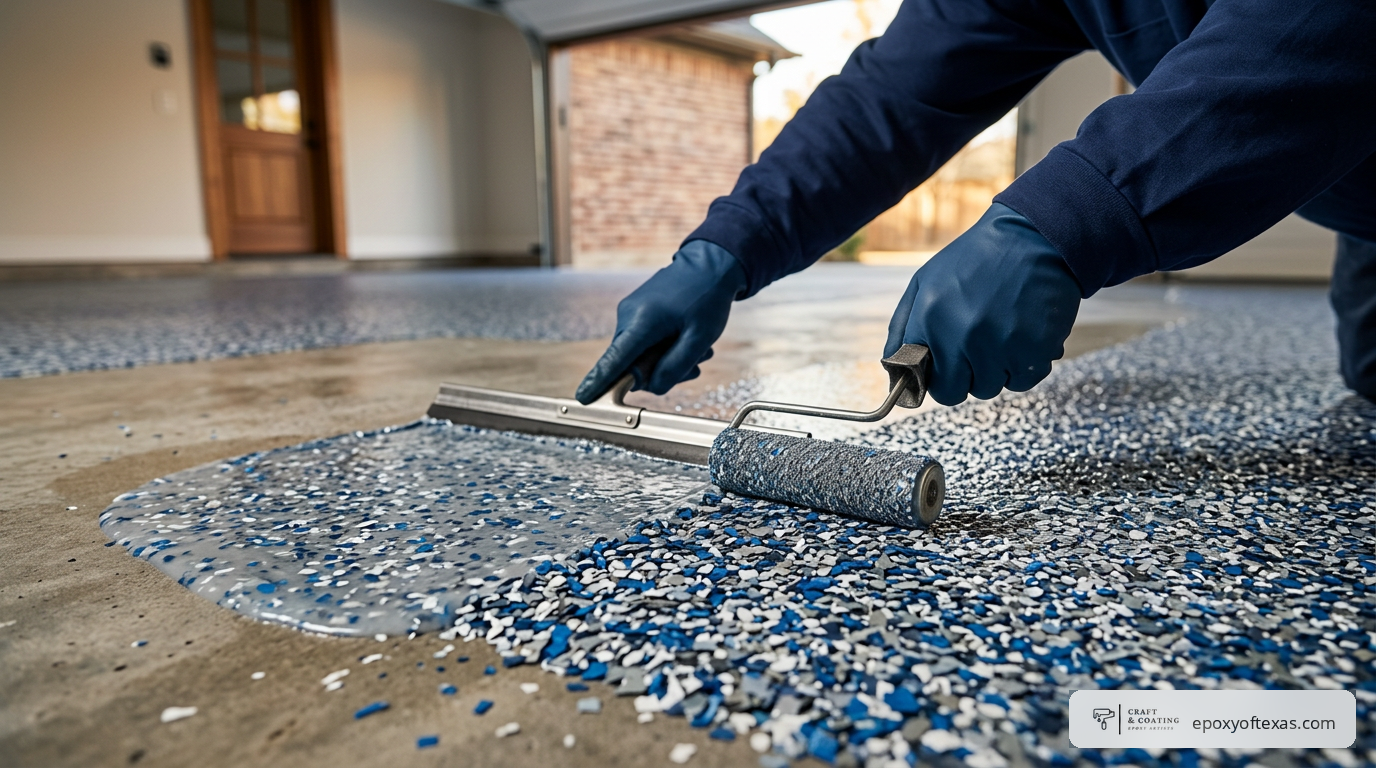
Base coat application follows, with contractors spreading epoxy using specialized tools to achieve uniform thickness. Decorative elements like color flakes, metallic pigments, or custom patterns are broadcast during this phase while the epoxy remains tacky, ensuring permanent integration.
Topcoat sealing provides the final protective layer, adding UV resistance, enhanced chemical protection, and the desired gloss level. Multiple topcoat layers increase durability and longevity, particularly in high-traffic applications.
Learn more about the professional installation process in our guide to Professional Epoxy Floor Installation in Austin TX.
What Return on Investment Can Texas Homeowners Expect?
Residential epoxy flooring delivers returns through multiple channels beyond simple aesthetic improvement. Understanding these value propositions helps homeowners evaluate epoxy as a strategic investment rather than merely a cosmetic upgrade.
Property value enhancement manifests most clearly in competitive real estate markets like Austin, where homes with epoxy garage floors sell 15-20% faster than comparable properties. While exact price premiums vary by neighborhood and overall home condition, epoxy installations consistently appear in listing highlights and appeal to buyers seeking turnkey properties.
Maintenance cost reduction provides ongoing savings throughout the flooring’s lifespan. Epoxy eliminates the need for repeated concrete sealing, reduces cleaning time and product costs, and prevents the concrete deterioration that necessitates expensive repairs or replacement. Over a typical 15-year lifespan, these savings can offset significant portions of initial installation costs.
Energy efficiency improvements occur in climate-controlled spaces where epoxy’s reflective properties reduce lighting requirements and its thermal mass characteristics moderate temperature fluctuations. While not dramatic, these contributions support overall home efficiency in Texas’s extreme climate.
Durability value becomes apparent when comparing epoxy’s 10-20+ year lifespan to alternative flooring options requiring replacement every 5-8 years. This longevity is particularly valuable in high-use areas like garages where vehicle traffic, tool impacts, and chemical exposure quickly degrade lesser coatings.
For commercial property owners evaluating similar investments, our Commercial Epoxy Flooring in Texas: Complete 2026 Guide provides parallel insights for business applications.
Key Takeaways
- Market Growth: North American epoxy flooring market projected to reach $3.1 billion by 2030, with Texas as a major growth hub driven by residential adoption.
- Cost Range: Residential epoxy flooring in Texas costs between $3 to $20+ per square foot depending on quality, complexity, and application type, with premium installations commanding higher investment.
- Climate Resilience: Properly formulated epoxy systems withstand Texas temperature extremes from freezing to 140°F+ surface temperatures while providing moisture barrier protection.
- Real Estate Value: Homes with epoxy garage floors sell 15-20% faster in competitive markets like Austin, demonstrating measurable ROI for homeowners.
- Application Diversity: Beyond garages, Texas homeowners are installing epoxy in kitchens, basements, living areas, and outdoor spaces for durability and modern aesthetics.
- Lifespan Advantage: Quality epoxy installations last 10-20+ years compared to 5-8 years for basic coatings, reducing long-term flooring costs.
- Professional Installation: Success requires proper surface preparation, quality materials, and experienced contractors familiar with Texas-specific climate challenges.
People Also Ask
How long does residential epoxy flooring last in Texas?
Residential epoxy flooring in Texas typically lasts 10-15 years for standard applications and 15-20+ years for premium installations when properly maintained. Texas’s climate extremes require quality formulations and professional installation to achieve these lifespans.
Is epoxy flooring worth it for Texas homes?
Yes, epoxy flooring provides significant value for Texas homes through durability in extreme climates, moisture resistance, easy maintenance, and measurable real estate advantages. Homes with epoxy garage floors sell 15-20% faster in competitive markets like Austin, demonstrating clear return on investment.
Can epoxy flooring withstand Texas heat?
High-quality epoxy formulations designed for Texas conditions maintain bond integrity and flexibility across temperature ranges from freezing to 140°F+ surface temperatures. Proper material selection and professional installation are essential for heat resistance in Texas climates.
What rooms in Texas homes benefit most from epoxy flooring?
Garages remain the primary application, but Texas homeowners increasingly install epoxy in kitchens, basements, laundry rooms, mudrooms, and outdoor patios. Each application leverages epoxy’s moisture resistance, durability, and easy-clean properties suited to Texas living.
How do I choose an epoxy flooring contractor in Texas?
Select contractors with verifiable Texas project portfolios, proper licensing and insurance, detailed written warranties, and experience with climate-specific formulations. Austin has 90 verified contractors, making thorough vetting essential for quality results.
Does epoxy flooring work in humid Texas climates?
Yes, epoxy excels in humid conditions by creating a moisture barrier that prevents water vapor transmission through concrete. This property makes it particularly valuable in Gulf Coast regions and areas with high water tables or seasonal flooding risks.
Frequently Asked Questions
What is the average cost of residential epoxy flooring in Texas?+
Residential epoxy flooring in Texas ranges from $3 to $20+ per square foot depending on application type, surface condition, and design complexity. Standard residential applications typically fall between $8-$12 per square foot, while premium installations with decorative elements exceed this range. Pricing varies based on your specific project requirements, and we recommend requesting a custom quote for accurate estimates.
How long does epoxy flooring installation take?+
Typical residential epoxy installations require 2-4 days including surface preparation, coating application, and curing time. Larger projects or complex designs may extend this timeline, while smaller single-room applications can sometimes be completed faster. Proper curing is essential for longevity, so rushing the process compromises results.
Can I install epoxy flooring myself in Texas?+
While DIY epoxy kits exist, professional installation is strongly recommended for Texas homes due to climate-specific challenges requiring proper surface preparation, moisture testing, and material selection. Professional contractors achieve better adhesion, longer lifespans, and superior aesthetics while providing warranties that protect your investment.
What maintenance does epoxy flooring require?+
Epoxy flooring requires minimal maintenance including regular sweeping or dust mopping, occasional damp mopping with pH-neutral cleaners, and prompt cleanup of spills. Avoid abrasive cleaners or tools that can scratch the surface. Properly maintained epoxy floors retain their appearance and performance for 10-20+ years in Texas homes.
Is epoxy flooring slippery when wet?+
Standard epoxy can be slippery when wet, but contractors add slip-resistant additives, texturing agents, or non-slip aggregates to enhance traction. This is particularly important for Texas outdoor applications like pool decks and patios where water exposure is common. Discuss slip resistance requirements during your consultation.
What colors and finishes are available for residential epoxy?+
Residential epoxy offers virtually unlimited color options including solid colors, color flake systems, metallic finishes, and custom blends. Gloss levels range from matte to high-gloss depending on aesthetic preferences and practical considerations. Texas homeowners increasingly choose earth tones, grays, and metallics that complement modern design trends.
Does epoxy flooring increase home value in Texas?+
Yes, epoxy flooring increases home value through faster sale times and enhanced buyer appeal, with homes featuring epoxy garage floors selling 15-20% faster in competitive Texas markets. While exact price premiums vary by location and overall home condition, epoxy installations consistently appear in listing highlights as desirable features.
Ready to Transform Your Texas Home with Professional Epoxy Flooring?
Whether you are upgrading your garage, modernizing your kitchen, or protecting your basement, professional epoxy installation delivers lasting value for Texas homeowners. With proven durability in extreme climates, measurable real estate advantages, and aesthetic versatility, epoxy flooring represents a strategic investment in your home’s functionality and appeal.
Contact Epoxy of Texas today for a custom consultation and detailed quote specific to your project requirements. Our team brings specialized expertise in Texas climate challenges and delivers installations backed by comprehensive warranties and decades of combined experience.