How Long Does Epoxy Floor Last in Austin: Complete 2026 Lifespan Guide
Quick Answer
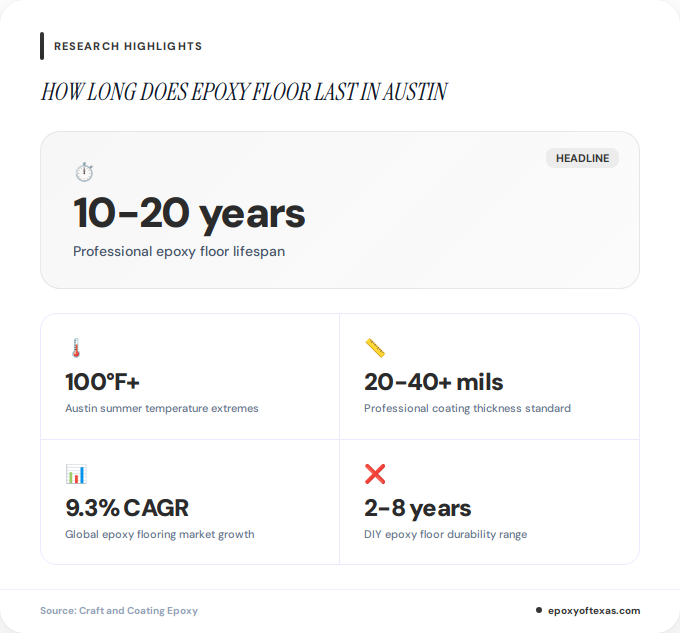
Properly installed professional epoxy floors in Austin last 10-20 years on average, with premium multi-layer systems potentially reaching 15-30 years under optimal conditions and maintenance. Basic or DIY versions may fail in just 2-8 years, especially when confronted with Austin’s intense heat, UV exposure, and temperature swings that exceed 100°F in summer.
When you invest in epoxy flooring for your Austin garage, warehouse, or commercial space, one question dominates the decision-making process: how long will it actually last? With temperatures regularly soaring past 100°F in summer and the relentless Texas sun beating down year-round, Austin presents unique challenges that can significantly impact flooring durability. The answer isn’t simple, as lifespan varies dramatically based on installation quality, system type, and maintenance practices.
The global epoxy flooring market is experiencing explosive growth, expanding at a 9.3% CAGR from $662 million in 2025 to a projected $1,110 million by 2031. This surge reflects increasing demand across residential, commercial, and industrial sectors, particularly in hot climates where property owners seek durable, heat-resistant solutions. Understanding what determines longevity in Austin’s challenging environment can save you thousands in premature replacement costs.
What Determines How Long Epoxy Floors Last in Austin?
The lifespan of an epoxy floor depends on multiple interconnected factors, with installation quality ranking as the single most critical variable. Surface preparation, coating thickness, product quality, traffic levels, and environmental exposure all play pivotal roles in determining whether your floor lasts 3 years or 30 years.
Professional installers understand that proper surface preparation is non-negotiable for achieving maximum durability. Grinding, shot-blasting, or diamond-grinding the concrete creates the mechanical bond necessary for long-term adhesion. Skipping this step, as many DIY projects do, can cause complete delamination in under a year, regardless of product quality.
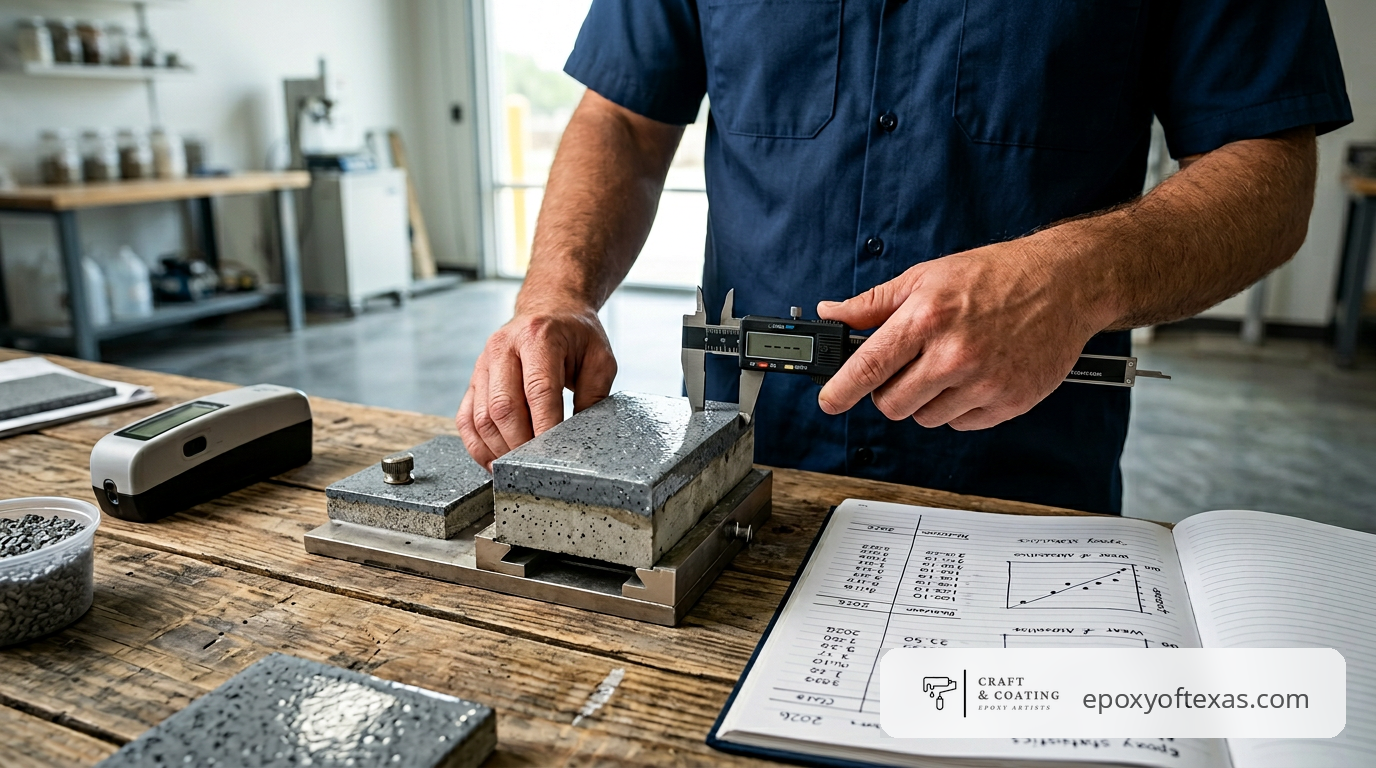
Coating thickness directly correlates with durability. Professional systems applied at 20-40+ mils thickness withstand wear patterns, chemical exposure, and thermal cycling far better than thin DIY kits applied at just 3-5 mils. Each additional layer adds protection, impact resistance, and years to the floor’s functional life.
Traffic patterns significantly influence longevity. Residential garage floors with light vehicle traffic and foot traffic can exceed 20 years with proper care. Commercial and industrial environments with heavy machinery, forklift traffic, or chemical exposure typically see 5-10 year lifespans before requiring recoating or replacement.
How Does Austin’s Climate Affect Epoxy Floor Durability?
Austin’s climate presents distinct challenges that separate it from cooler regions. Summer temperatures regularly exceed 100°F, creating extreme thermal expansion and contraction cycles in concrete slabs. This movement stresses the epoxy bond, particularly at the edges and in areas with existing cracks or poor substrate preparation.
UV exposure is another critical factor. Austin receives intense sunlight year-round, and without UV-stable topcoats, standard epoxy formulations yellow, chalk, and degrade within 5-8 years. Premium polyaspartic or aliphatic polyurethane topcoats resist UV degradation, maintaining clarity and strength for 15-20+ years even in south-facing garages or partially covered outdoor applications.
Temperature swings between scorching summer days and occasional winter freezes create moisture vapor transmission issues. Concrete slabs release moisture as they heat up, and if the epoxy coating lacks proper moisture mitigation primers, this vapor pressure can cause bubbling, peeling, or complete delamination. Professional installers in the Austin area use moisture barrier systems specifically designed for Texas climate conditions.
Humidity fluctuations also impact curing times and long-term performance. High humidity during installation can extend cure times and affect final hardness. Conversely, extremely dry conditions can cause rapid curing that leads to surface defects. Experienced contractors adjust application timing and product formulations to account for Austin’s variable humidity levels throughout the year.
How Do Different Epoxy Systems Compare for Longevity?
Not all epoxy systems are created equal. The range between a weekend DIY kit and a professional multi-layer system represents the difference between 2 years and 30 years of service life. Understanding these distinctions helps you make informed decisions about which investment level matches your needs and expectations.
| System Type | Thickness | Austin Lifespan |
|---|---|---|
| DIY Kits | 3-5 mils | 2-5 years |
| Single-Coat Professional | 8-15 mils | 3-7 years |
| Multi-Layer Professional | 20-40+ mils | 10-20+ years |
| Premium High-Performance | 40+ mils | 15-30+ years |
DIY kits from big-box retailers typically fail within 2-5 years in Austin conditions. These products use water-based or low-solids formulations that lack the cross-link density and thickness needed to withstand thermal cycling and vehicle traffic. Poor surface preparation compounds these limitations, leading to peeling, bubbling, or tire-track wear patterns within months.
Single-coat professional systems offer moderate improvement, lasting 3-7 years under typical garage use. These installations include proper surface preparation but lack the layered protection and UV-resistant topcoats that extend lifespan in harsh climates. They work adequately for light-duty applications or temporary solutions.
Multi-layer professional systems represent the industry standard for residential and commercial applications. These installations include moisture-blocking primers, pigmented base coats, decorative flake or quartz aggregate layers, and UV-stable polyaspartic or polyurethane topcoats. With proper maintenance, these systems reliably deliver 10-20 years of service in Austin’s demanding environment.
Premium high-performance systems utilize the thickest coatings, highest-grade resins, and advanced UV inhibitors. Designed for commercial and industrial applications, these floors can achieve 15-30+ years of lifespan even under heavy use, though they typically require recoating every 8-10 years to maintain appearance and protective qualities.
Why Does Professional Installation Matter for Lifespan?
The difference between professional and DIY installation extends far beyond aesthetics. Professionals bring specialized equipment, product knowledge, and installation techniques that directly impact how long your epoxy floor will last. In Austin’s challenging climate, these differences become even more pronounced.
Surface preparation quality determines bond strength. Professional contractors use industrial diamond grinders or shot-blasting equipment to create the proper concrete surface profile (CSP 2-4 rating). This mechanical preparation removes laitance, opens concrete pores, and creates the micro-texture necessary for maximum adhesion. DIY approaches using acid etching or simple cleaning rarely achieve adequate preparation, leading to premature delamination within the first year.
Moisture testing prevents costly failures. Professionals assess concrete moisture content using calcium chloride tests or relative humidity probes before installation. Austin’s concrete slabs often retain moisture from recent construction, seasonal rains, or underground sources. Installing epoxy over damp concrete guarantees failure, while proper moisture mitigation primers resolve these issues before they cause problems.
Product selection and mixing accuracy affect curing and final properties. Professional-grade epoxy systems require precise ratio mixing, often with additives adjusted for temperature and humidity conditions. Improper mixing ratios lead to incomplete curing, reduced strength, and shortened lifespan. Professionals use calibrated pumps and follow strict protocols to ensure optimal chemical reactions.
Application timing and environmental control influence final performance. Contractors schedule installations during optimal temperature windows, typically between 50-90°F with moderate humidity. They control substrate temperature, avoid direct sunlight during application, and allow proper cure times between coats. These factors significantly impact cross-link density and long-term durability.
How Can You Extend Your Epoxy Floor’s Lifespan?
Even the highest-quality epoxy installation requires proactive maintenance to achieve maximum lifespan. Simple care practices can add 5-10 years to your floor’s functional life, while neglect can cut even premium systems short of their potential.
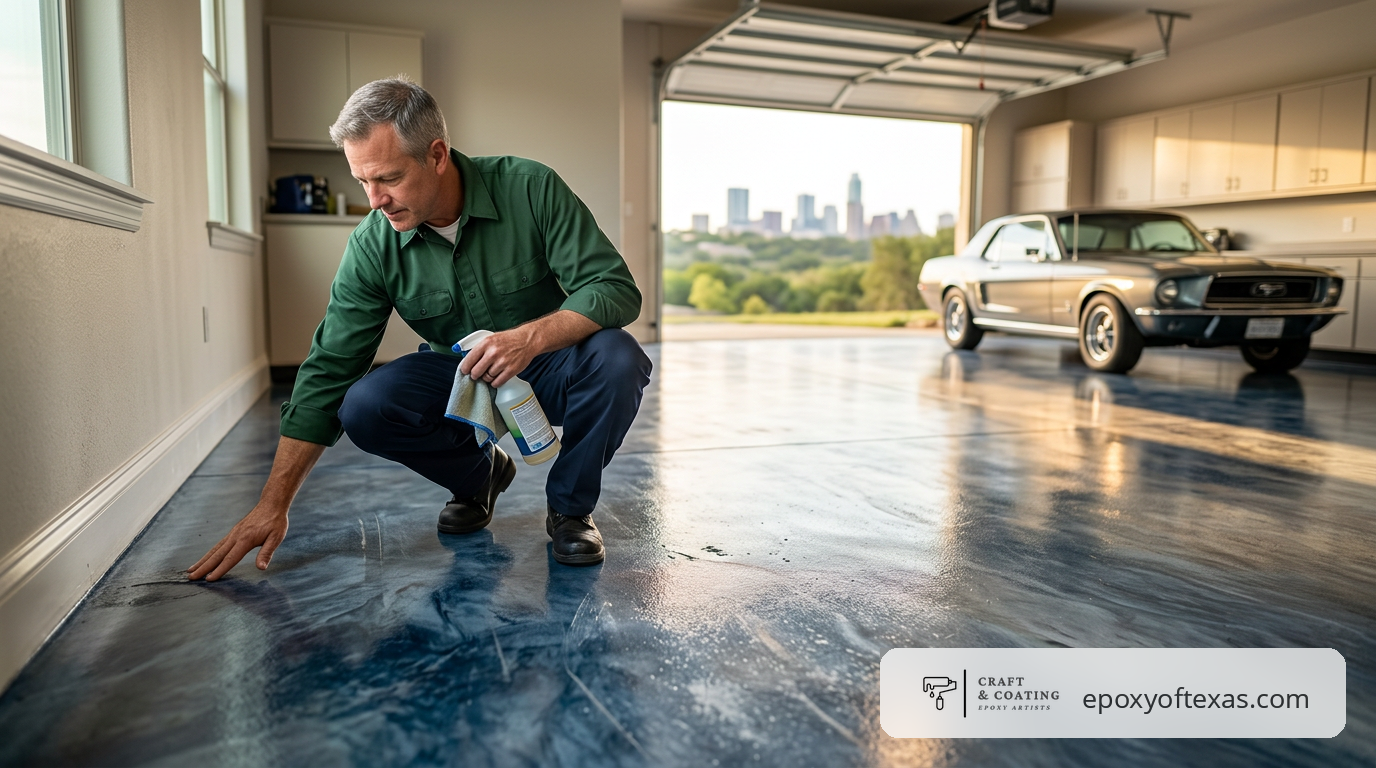
Regular cleaning prevents abrasive damage. Sweeping or dust-mopping removes sand, dirt, and debris that acts as sandpaper under foot and vehicle traffic. For deeper cleaning, use pH-neutral cleaners specifically formulated for epoxy floors. Avoid harsh chemicals, acidic cleaners, or abrasive scrubbing that can dull the topcoat or compromise the protective seal.
Protect high-wear areas with mats or padding. Place protective mats under workbenches, tool chests, and other heavy equipment that might be dragged across the floor. Use jack stands with rubber pads when working on vehicles to prevent point-load damage. These simple measures prevent the concentrated wear that leads to coating breakdown in traffic patterns.
Address spills and stains promptly. While epoxy resists most automotive fluids, prolonged exposure to battery acid, brake fluid, or strong solvents can etch or soften the coating. Clean spills within 24 hours to prevent staining or chemical damage. For stubborn stains, use manufacturer-approved spot cleaners rather than harsh solvents.
Recoat before complete failure occurs. Most professional epoxy floors benefit from topcoat renewal every 5-10 years, depending on traffic levels. This preventive recoating costs a fraction of complete replacement and can extend total lifespan to 20-30+ years. Watch for signs like dullness, minor scratching, or UV yellowing that indicate it’s time for a fresh topcoat.
Control thermal shock and protect from extreme heat. Avoid placing extremely hot items directly on the floor, as thermal shock can cause localized delamination. In Austin’s summer heat, be cautious with welding operations or hot metal objects. Use heat-resistant pads or boards to distribute thermal loads and protect the coating.
What Should You Expect to Invest in Long-Lasting Epoxy?
Understanding the relationship between investment and lifespan helps you make cost-effective decisions. While initial costs vary widely, calculating cost-per-year of service reveals that premium installations often deliver superior long-term value compared to budget alternatives.
Epoxy flooring costs in Austin range from $3-15+ per square foot, with pricing varying based on scope, materials, surface condition, and system complexity. A typical two-car garage (400-500 sq ft) might range from $1,200 to $6,000+ depending on whether you choose a basic single-coat system or a premium multi-layer installation with decorative elements and advanced topcoats.
Budget DIY kits cost $200-500 for materials but often require replacement within 2-5 years, resulting in a cost-per-year of $40-250. Mid-range professional installations at $1,500-3,000 lasting 10-15 years cost just $100-300 annually. Premium systems at $3,000-6,000+ lasting 20-30 years deliver the lowest annual cost at $100-200 per year, plus they maintain property value and visual appeal throughout their lifespan.
Commercial and industrial applications involve different economics. Larger spaces (3,000-10,000+ sq ft) benefit from economies of scale, but heavy-duty requirements demand thicker coatings and more frequent maintenance. For commercial epoxy flooring in Texas, pricing varies based on your specific project requirements, downtime constraints, and performance specifications.
Installation timeframes also factor into total project costs. Residential garage installations in Austin typically complete in 2-4 days, including surface prep, coating application, and cure time. Commercial projects averaging 3,994 square feet require 5-10 days, while large industrial installations can extend to 2-3 weeks depending on complexity and required cure times between production activities.
When evaluating quotes, consider warranty coverage, maintenance requirements, and expected recoating intervals. A slightly higher upfront investment in UV-stable topcoats, moisture mitigation, or thicker base coats can eliminate premature yellowing, delamination, or wear that would otherwise require expensive repairs. Position your investment as a long-term property improvement rather than a short-term cosmetic upgrade.
Key Takeaways
- Professional epoxy floors in Austin last 10-20 years on average, with premium systems reaching 15-30 years under optimal conditions, while DIY installations typically fail within 2-5 years due to inadequate preparation and thin coatings.
- Austin’s climate significantly impacts epoxy durability, with temperatures exceeding 100°F, intense UV exposure, and thermal cycling requiring UV-stable topcoats and heat-resistant formulations to prevent yellowing and delamination.
- Surface preparation is the single most critical factor for longevity, with professional grinding or shot-blasting creating the mechanical bond necessary for multi-decade performance versus DIY approaches that often fail within one year.
- Multi-layer systems vastly outperform single-coat applications, with 20-40+ mil thickness providing superior wear resistance, chemical protection, and thermal stability compared to thin 3-5 mil DIY kits.
- Regular maintenance extends lifespan significantly, with proper cleaning, prompt spill cleanup, and preventive recoating every 5-10 years adding years to total service life and maintaining visual appeal.
- Investment cost-per-year favors premium installations, as higher upfront costs spread across 20-30 year lifespans deliver better value than budget options requiring replacement every 3-5 years.
- The epoxy flooring market is growing at 9.3% annually, reflecting increased demand for durable, long-lasting solutions in hot climates like Austin, with improved formulations and application techniques extending achievable lifespans.
People Also Ask
Can epoxy floors handle Austin’s 100°F+ temperatures?
Yes, properly formulated epoxy with heat-resistant additives and UV-stable topcoats handles Austin’s extreme temperatures effectively. Premium polyaspartic or aliphatic polyurethane topcoats resist thermal degradation and UV yellowing for 15-20+ years even in direct sunlight and scorching summer heat.
How long does it take to install epoxy flooring in Austin homes?
Residential garage installations in Austin typically require 2-4 days from start to finish, including surface preparation, primer application, base coats, decorative elements, and topcoat curing. Commercial projects take 5-10 days on average, while large industrial installations may extend to 2-3 weeks depending on square footage and complexity.
What causes epoxy floors to fail prematurely in Texas?
The most common failure causes are inadequate surface preparation creating poor adhesion, moisture vapor transmission through the concrete slab, and UV degradation from intense sunlight. Using thin DIY coatings without proper primers, UV inhibitors, or moisture barriers leads to peeling, bubbling, yellowing, and complete delamination within 1-5 years.
Is epoxy flooring worth the investment for Austin homeowners?
Professional epoxy installations deliver excellent value for Austin homeowners, with 10-20 year lifespans providing durable, attractive floors that resist heat, chemicals, and wear. When properly installed and maintained, the cost-per-year often beats alternatives like tile or coated concrete, plus it enhances property value and creates usable, climate-controlled garage space.
How often does epoxy flooring need recoating in Austin?
Most professional epoxy floors in Austin benefit from topcoat renewal every 5-10 years depending on traffic levels and UV exposure. High-traffic commercial spaces may require recoating every 3-5 years, while residential garages with light use can extend to 10-15 years before needing a fresh protective topcoat.
What’s the difference between epoxy and polyaspartic coatings?
Epoxy serves as the primary base coating providing adhesion and build thickness, while polyaspartic functions as a UV-stable topcoat that resists yellowing and chemical damage. In Austin’s climate, combining epoxy base coats with polyaspartic topcoats delivers optimal longevity by leveraging epoxy’s strength with polyaspartic’s superior UV and thermal resistance.
Frequently Asked Questions
How long does epoxy floor last in Austin compared to other cities?+
Austin’s hot climate and intense UV exposure can reduce basic epoxy lifespans by 20-30% compared to cooler regions, shortening standard coatings to 5-8 years versus 10-12 years elsewhere. However, properly specified UV-stable systems with heat-resistant formulations perform equally well in Austin as in temperate climates, achieving the same 15-20+ year lifespans when professionally installed and maintained.
Can I install epoxy flooring myself and still get 10+ years of life?+
Achieving 10+ year lifespans with DIY installation is extremely challenging and unlikely with standard retail kits. Success requires professional-grade equipment for surface preparation, commercial-grade epoxy products, precise moisture testing, proper ratio mixing, and ideal environmental conditions during application. Most DIY installations fail within 2-5 years due to inadequate preparation or improper application techniques.
What warranty should I expect on professional epoxy installation?+
Reputable contractors typically offer 5-10 year warranties on professional residential installations and 3-5 years on commercial applications. Premium systems may include 10-15 year warranties covering delamination, significant wear-through, or UV yellowing. Warranties usually exclude damage from improper maintenance, chemical spills, or physical abuse, so review coverage details carefully before committing.
Does hot tire pickup damage epoxy floors in Austin garages?+
Hot tire pickup occurs when heat-softened tires leave marks or pull coating material, particularly with budget epoxy systems in Austin’s summer heat. Premium formulations with higher heat deflection temperatures and polyaspartic topcoats resist hot tire pickup effectively. Allowing vehicles to cool 30-60 minutes before parking and using heat-resistant coatings prevents this common Austin problem.
How do I know when my epoxy floor needs replacement versus recoating?+
Surface dullness, minor scratching, or UV yellowing indicate it’s time for topcoat renewal, which extends life economically. Complete replacement becomes necessary when you observe widespread delamination, bubbling, significant cracking, or wear-through to bare concrete in traffic patterns. A professional assessment can determine whether recoating or full replacement offers better long-term value for your specific situation.
Are there eco-friendly epoxy options with similar longevity?+
Low-VOC and water-based epoxy formulations offer reduced environmental impact while maintaining good durability for light-duty residential applications. However, solvent-based and 100% solids epoxy systems still deliver superior longevity, chemical resistance, and heat tolerance in Austin’s demanding climate. Eco-friendly options work well for indoor spaces with climate control but may fall short of 15-20+ year lifespans in challenging environments.
What maintenance products should I use on my Austin epoxy floor?+
Use pH-neutral cleaners specifically formulated for epoxy floors, avoiding acidic or alkaline products that can dull or damage the topcoat. Simple solutions like mild dish soap in water work effectively for routine cleaning. Avoid abrasive scrubbers, harsh solvents, or steam cleaners that can compromise the protective seal and reduce lifespan significantly.