
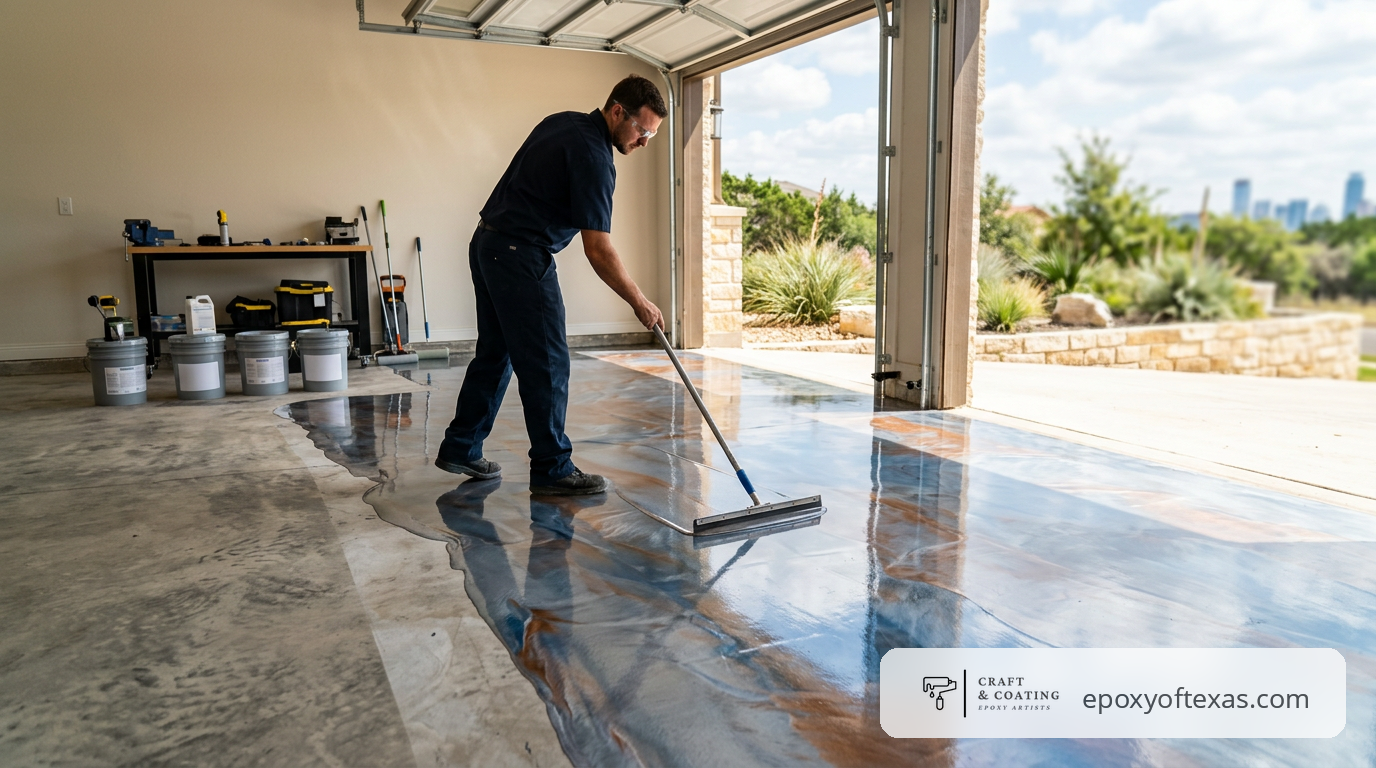
Epoxy Flooring Austin in Texas: Complete 2026 Guide to Costs, Contractors, and Installation
Quick Answer
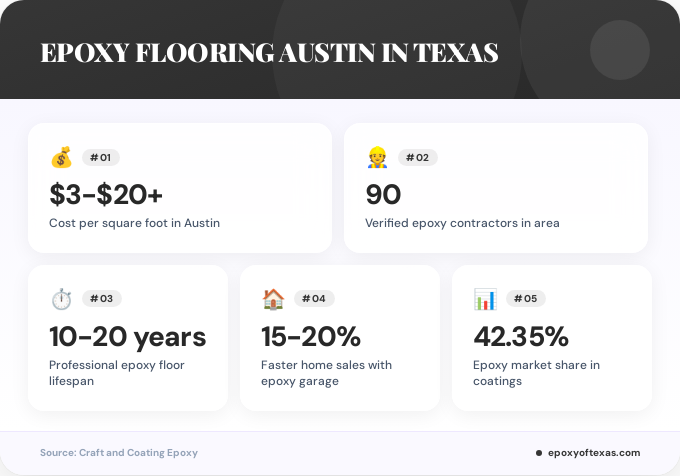
Epoxy flooring in Austin, Texas costs between $3 and $20+ per square foot in 2026, with around 90 verified contractors serving the area across residential, commercial, and industrial projects. Professionally installed epoxy floors deliver 10-20 year lifespans with superior durability, chemical resistance, and aesthetic versatility suited to Texas’s demanding climate conditions.
Austin’s booming construction sector and expanding industrial footprint have created unprecedented demand for durable, high-performance flooring solutions. With 90 verified epoxy flooring contractors operating across the metro area in 2026 and homes featuring epoxy garage floors selling 15-20% faster than comparable properties, this coating technology has become essential infrastructure for residential, commercial, and industrial spaces throughout central Texas.
The convergence of Austin’s explosive growth, extreme temperature variations, and demand for sustainable building materials positions epoxy flooring as a critical component of modern construction and renovation projects. From Tesla’s Gigafactory to neighborhood garages in Westlake Hills, epoxy systems deliver unmatched durability in one of America’s fastest-growing metropolitan regions.
What Is Epoxy Flooring and Why Is It Popular in Austin?
Epoxy flooring consists of thermosetting resin systems that bond directly to concrete substrates, creating seamless, highly durable surfaces resistant to chemicals, abrasion, and moisture. The technology combines epoxide resins with polyamine hardeners in precise ratios, triggering exothermic curing reactions that transform liquid coatings into rock-solid surfaces within 24-72 hours.
In Austin specifically, epoxy’s popularity stems from exceptional performance in Texas’s challenging climate. Summer temperatures regularly exceed 100°F, while winter freezes create thermal cycling stresses that devastate lesser coatings. Modern epoxy formulations withstand this temperature variability while maintaining structural integrity across industrial warehouses, commercial retail spaces, and residential garages throughout Travis County.
The material’s technical advantages extend beyond climate resilience. Epoxy floors achieve compressive strengths exceeding 10,000 psi and Shore D hardness ratings between 70-85, making them ideal for heavy machinery environments common in Austin’s manufacturing sector. Additionally, professional installations from experienced Texas contractors deliver chemical resistance crucial for automotive workshops, food processing facilities, and pharmaceutical manufacturing operations expanding throughout the region.
How Big Is the Epoxy Flooring Market in Austin and Texas?
The US floor coatings market reached USD 1.99 billion in 2026, with projections indicating growth to USD 2.43 billion by 2031 at a 4.12% CAGR. Epoxy maintains a commanding 42.35% market share within this sector, driven primarily by manufacturing applications and industrial expansion. Texas sees particularly strong growth from commercial construction activity contributing +1.2% CAGR impact and electric vehicle manufacturing plus data center builds adding another +0.5%.
Across North America, epoxy flooring valuations reached USD 1.92 billion in 2024, climbing toward USD 3.1 billion by 2030 at an 8.3% CAGR. This aggressive expansion reflects accelerating warehouse construction, manufacturing reshoring initiatives, and increasing adoption of low-VOC sustainable formulations that align with corporate environmental commitments.
| Market Segment | 2026 Value | 2030-2031 Projection |
|---|---|---|
| US Floor Coatings | $1.99 billion | $2.43 billion (4.12% CAGR) |
| North America Epoxy | $1.92 billion (2024) | $3.1 billion (8.3% CAGR) |
| Global Epoxy Flooring | $662 million (2025) | $1,110 million (9.3% CAGR) |
In Austin specifically, the contractor landscape includes 10 minority-owned and 7 women-owned businesses among the 90 verified operators, reflecting the city’s commitment to diversity in construction trades. Recent project tracking shows 18 installations averaging 3,994 square feet each, spanning residential garages in Tarrytown, warehouses in Southeast Austin’s industrial corridor, and commercial retail spaces along South Congress.
What Does Epoxy Flooring Cost in Austin, Texas?
Epoxy flooring pricing in Austin varies dramatically based on project scope, substrate conditions, coating complexity, and performance requirements. Basic garage applications start at $3 to $8 per square foot for standard two-coat systems, while premium decorative installations with metallic finishes, custom colors, or specialized chemical resistance range from $10 to $20+ per square foot.
These ranges reflect multiple cost drivers unique to the Austin market. Labor premiums run 15-20% above Texas state averages due to skilled applicator shortages and high demand from concurrent construction projects. Surface preparation alone consumes 60% of labor hours, requiring diamond grinding, crack repair, and moisture mitigation before coating application can begin.
Pricing also varies significantly by application type. Residential garages typically represent the lower cost spectrum with simpler color schemes and standard traffic loads. Industrial facilities requiring FDA-compliant antimicrobial coatings, static-dissipative properties, or extreme chemical resistance command premium pricing ranging from $12 to $25+ per square foot depending on specification complexity and certification requirements.
When evaluating quotes, Austin property owners should prioritize value over initial cost. Quality installations deliver 10-20 year lifespans with minimal maintenance, while budget alternatives may fail within 2-5 years due to inadequate surface preparation, inferior resins, or improper mixing ratios. Pricing varies based on your specific project requirements, substrate conditions, and performance expectations, making custom quotes essential for accurate budgeting.
What Are the Technical Specifications and Performance Metrics?
Modern epoxy flooring systems deliver exceptional engineering properties critical for Austin’s demanding commercial and industrial environments. Standard two-coat applications achieve 10-20 mil thickness (250-500 microns), providing substantial wear resistance while maintaining economical material consumption. High-build systems specified for heavy manufacturing or logistics facilities may reach 40-80 mils with aggregate broadcasts for enhanced slip resistance and impact protection.
Mechanical performance specifications include compressive strength exceeding 10,000 psi, enabling support for forklift traffic, heavy machinery, and concentrated point loads without substrate damage. Shore D hardness ratings between 70-85 prevent gouging, scratching, and wear from metal wheels, pallets, and dropped tools common in warehouse operations throughout the Austin metro area.
Shore D Hardness: 70-85
Tensile Strength: 3,000+ psi
Cure Time: 24-72 hours
Full Cure: 7-14 days
Abrasion Resistance: CS-17 rating
Impact Resistance: 160 in-lbs
Solvent Resistance: Excellent
Thermal Shock: -40°F to 180°F
Chemical resistance proves particularly valuable in Austin’s automotive service sector and emerging pharmaceutical manufacturing cluster. Quality epoxy systems withstand continuous exposure to oils, solvents, acids, and alkaline cleaning agents with pH ranges from 2-12 without degradation. Thermal shock resistance spanning -40°F to 180°F accommodates the temperature extremes common in Texas manufacturing environments and loading dock areas.
Advanced formulations now incorporate UV stabilizers and heat-reflective pigments specifically engineered for Austin’s intense solar exposure. These enhancements prevent the yellowing and chalking that plagued earlier epoxy generations, maintaining aesthetic appeal throughout the coating’s service life while reducing cooling costs in warehouse and retail applications.
What Are the Primary Applications for Epoxy Flooring in Austin?
Epoxy flooring serves diverse applications across Austin’s residential, commercial, and industrial sectors. Residential garages represent the highest-volume segment, with homeowners throughout Westlake, Barton Creek, and Hyde Park upgrading concrete floors to increase property values and functional utility. Data indicates properties with professionally installed epoxy garage floors sell 15-20% faster than comparable listings with untreated concrete.
Commercial retail environments increasingly specify epoxy for showrooms, restaurants, and specialty shops along South Congress, East Sixth Street, and The Domain. Seamless installation eliminates grout lines that harbor bacteria, while customizable colors and patterns enable distinctive branding. Antimicrobial variants meet health department requirements for food service applications, contributing to Austin’s reputation as a culinary destination.
Industrial facilities throughout Southeast Austin and Pflugerville rely on epoxy for manufacturing floors, warehouse logistics areas, and loading docks. The coating’s resistance to forklift traffic, chemical spills, and thermal cycling makes it essential infrastructure for distribution centers serving Texas’s sprawling geography. Recent growth in electric vehicle manufacturing and semiconductor fabrication has accelerated demand for static-dissipative epoxy formulations that prevent electrostatic discharge damage to sensitive components.
Healthcare facilities including urgent care clinics, dental offices, and veterinary hospitals specify epoxy for examination rooms, laboratories, and surgical suites. The material’s ability to achieve 2 LEED points for low-VOC content aligns with sustainable building certifications increasingly required for medical construction projects. Seamless surfaces eliminate contamination risks while simplifying compliance with stringent hygiene protocols.
How Sustainable and Eco-Friendly Is Epoxy Flooring?
Environmental considerations increasingly influence flooring decisions across Austin’s construction sector, with epoxy technology evolving rapidly to meet sustainability mandates. 90% of professional installations now utilize low-VOC or VOC-free formulations that minimize indoor air quality impacts during application and curing. These water-based and solvent-free systems comply with stringent emissions standards while delivering performance equivalent to traditional solvent-borne products.
Bio-based epoxy resins derived from renewable feedstocks currently represent 5% of market share but show strong growth trajectories as manufacturers develop plant-oil alternatives to petroleum-derived components. These innovations reduce carbon footprints while maintaining the mechanical properties and chemical resistance that define epoxy performance standards.
Life cycle analysis reveals epoxy’s sustainability advantages extend beyond material composition. The coating’s 10-20 year service life dramatically reduces replacement frequency compared to alternative flooring systems requiring renewal every 3-5 years. This longevity translates to reduced waste generation, lower transportation emissions from replacement material delivery, and decreased labor resource consumption over building lifecycles.
Carbon footprint calculations indicate epoxy production generates approximately 4.7 kg CO2 equivalent per kg of resin. However, energy savings from reflective light-colored coatings that reduce lighting requirements and thermal mass benefits that moderate HVAC loads offset these production emissions within 2-3 years of installation in typical commercial applications. Projects pursuing LEED certification can earn up to 2 credits through low-VOC epoxy specification combined with regional material sourcing from Texas manufacturers.
How Do You Choose the Right Epoxy Flooring Contractor in Austin?
Selecting qualified epoxy flooring contractors in Austin requires careful evaluation of experience, certifications, and project portfolios. The city’s 90 verified operators range from specialized residential applicators to commercial contractors managing multi-building industrial complexes. Verifying relevant experience in your specific application type prevents costly mistakes common when contractors work outside their expertise zones.
Certification requirements warrant particular attention. Reputable contractors maintain manufacturer certifications from major epoxy suppliers, demonstrating proficiency with specific product systems and installation protocols. These credentials ensure applicators understand mixing ratios, temperature requirements, and surface preparation standards critical to long-term performance. Insurance verification including general liability coverage of $1-2 million minimum plus workers compensation protects property owners from liability exposure.
Portfolio review should include projects comparable in scope, substrate conditions, and performance requirements to your intended installation. A contractor specializing in residential garages may lack the expertise for food-grade industrial flooring requiring FDA compliance. Request references from at least three recent projects, then conduct site visits to evaluate coating condition, aesthetic quality, and customer satisfaction levels 12-24 months post-installation.
Surface preparation capabilities represent perhaps the most critical evaluation criterion. Contractors must demonstrate proficiency with concrete moisture testing, crack repair techniques, and mechanical surface preparation using diamond grinders or shot blasters. 60% of installation labor involves preparation work that determines coating adhesion and longevity. Request detailed preparation protocols as part of proposal submissions to compare methodologies across competing contractors.
Warranty terms provide insight into contractor confidence and material quality. Standard warranties cover 3-5 years for residential applications and 5-10 years for commercial installations when properly maintained. Extended warranties often require specific maintenance protocols including periodic recoating or sealing. Review warranty exclusions carefully, as damage from chemical exposure, impact trauma, or substrate failure typically falls outside coverage regardless of installation quality.
What Are the Latest Trends in Epoxy Flooring Technology?
Epoxy flooring technology continues rapid evolution driven by performance demands, sustainability requirements, and aesthetic preferences. UV and heat-resistant formulations specifically engineered for Austin’s climate now deliver extended service lives exceeding 20 years in high-exposure applications. These systems incorporate advanced stabilizers that prevent the degradation common in earlier generations subjected to Texas’s intense solar radiation.
Graphene-reinforced epoxy represents cutting-edge development with 30% improvement in wear resistance compared to conventional formulations. The nanomaterial’s exceptional strength-to-weight ratio enables thinner applications that maintain mechanical performance while reducing material consumption and installation costs. Early adoption focuses on high-traffic commercial environments where accelerated wear justifies premium material pricing.
Smart coating technology integrating embedded sensors enables real-time monitoring of floor conditions in mission-critical facilities. These systems track temperature variations, moisture intrusion, and traffic patterns with 98% accuracy, providing predictive maintenance alerts before visible damage occurs. Distribution centers and pharmaceutical manufacturing facilities throughout Austin’s industrial corridors increasingly specify these intelligent systems to optimize maintenance scheduling and prevent costly production interruptions.
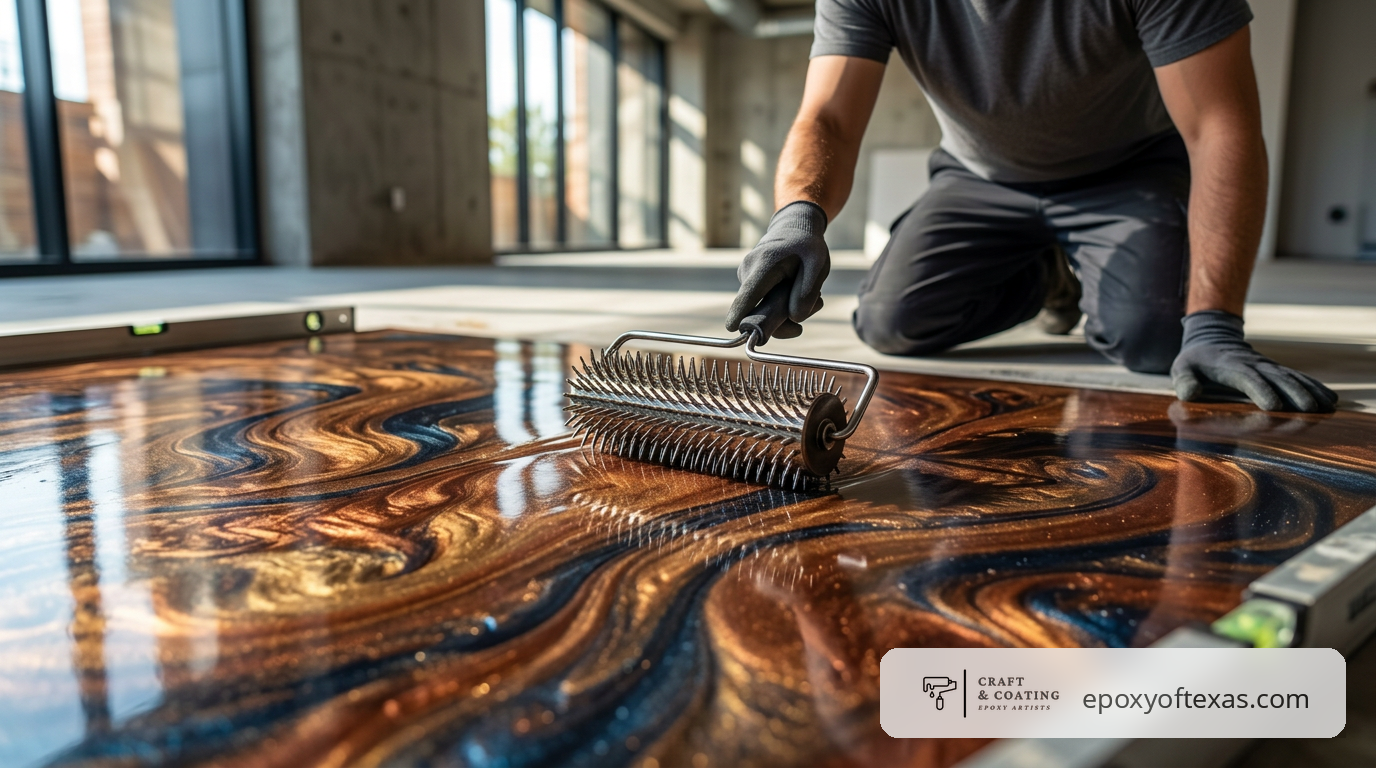
Metallic epoxy finishes continue dominating residential and commercial aesthetic trends, creating three-dimensional visual effects through specialized pigments and application techniques. These decorative systems transform basic concrete slabs into showpiece floors suitable for high-end retail, restaurant, and residential applications. Color customization capabilities enable precise brand matching for corporate facilities while creating distinctive visual identities for hospitality venues along Austin’s entertainment districts.
Antimicrobial additives integrated directly into epoxy matrices address heightened hygiene awareness across healthcare, food service, and educational facilities. Silver-ion and copper-based technologies inhibit bacterial growth on contact surfaces, complementing regular cleaning protocols. These enhancements prove particularly valuable in Austin’s expanding healthcare sector and align with post-pandemic facility management priorities emphasizing infection control.
Key Takeaways
- Austin hosts 90 verified epoxy flooring contractors serving residential, commercial, and industrial markets with pricing ranging from $3 to $20+ per square foot based on complexity and performance requirements.
- The US floor coatings market reached $1.99 billion in 2026 with epoxy commanding 42.35% market share, driven by manufacturing growth and commercial construction expansion across Texas.
- Professional installations deliver 10-20 year lifespans with compressive strengths exceeding 10,000 psi and Shore D hardness ratings of 70-85, ideal for Austin’s demanding climate and industrial applications.
- Properties with epoxy garage floors sell 15-20% faster in the Austin market, demonstrating clear return on investment for residential applications beyond functional benefits.
- 90% of installations now use low-VOC formulations that contribute up to 2 LEED points, aligning with sustainability mandates while maintaining superior chemical resistance and durability.
- Labor premiums run 15-20% above Texas averages in Austin due to skilled applicator shortages, with surface preparation consuming 60% of installation hours and determining long-term performance.
- Advanced technologies including graphene reinforcement, smart sensors, and antimicrobial additives represent the latest innovations addressing wear resistance, predictive maintenance, and hygiene requirements across diverse applications.
People Also Ask
How long does epoxy flooring last in Austin’s climate?
Professional epoxy installations in Austin typically last 10-20 years when properly maintained, with UV-resistant formulations specifically engineered for Texas’s intense solar exposure extending service life toward the upper end of this range. Climate-specific formulations prevent the yellowing and degradation common in earlier epoxy generations.
Can epoxy flooring withstand Austin’s summer heat?
Quality epoxy systems demonstrate excellent thermal stability across temperature ranges from negative 40°F to 180°F, easily accommodating Austin’s summer peaks exceeding 100°F. Modern formulations incorporate heat-resistant polymers and UV stabilizers that prevent softening, discoloration, and performance degradation during extended high-temperature exposure.
Is epoxy flooring slippery when wet?
Standard smooth epoxy can become slippery when wet, but contractors routinely add aluminum oxide, silica, or polymer aggregate broadcasts to create textured surfaces with excellent slip resistance. These treatments meet OSHA safety requirements for commercial and industrial applications while maintaining the coating’s chemical resistance and durability benefits.
How do I maintain epoxy floors in Austin?
Epoxy floor maintenance requires simple dry dust mopping or damp mopping with pH-neutral cleaners to remove dirt and debris. Avoid harsh chemicals, abrasive scrubbers, and high-pressure washing that can damage the coating surface, and address spills promptly to prevent staining despite epoxy’s superior chemical resistance.
Does epoxy flooring add value to Austin homes?
Properties with professionally installed epoxy garage floors sell 15-20% faster in the Austin market according to recent transaction data, demonstrating clear market preference for upgraded flooring. The combination of aesthetic appeal, durability, and low maintenance requirements appeals strongly to buyers throughout central Texas’s competitive real estate environment.
What is the best time of year to install epoxy flooring in Austin?
Spring and fall offer optimal installation conditions in Austin with moderate temperatures and lower humidity that facilitate proper curing. Summer installations require climate-controlled environments to manage rapid curing from high temperatures, while winter projects must account for slower cure times during occasional cold snaps below 50°F.
Frequently Asked Questions
How much does epoxy flooring cost for a two-car garage in Austin?+
A standard two-car garage (approximately 400-600 square feet) typically ranges from $1,200 to $12,000+ depending on coating quality, surface preparation requirements, and decorative elements. Basic solid-color systems start at the lower end while metallic finishes with custom colors and enhanced durability specifications reach premium pricing. Contact qualified Austin contractors for detailed quotes based on your specific garage conditions and aesthetic preferences.
Can I install epoxy flooring myself or should I hire professionals?+
While DIY epoxy kits exist for homeowner installation, professional application ensures proper surface preparation, moisture testing, and mixing ratios that determine long-term performance. Austin’s 90 verified contractors possess specialized equipment for concrete grinding, crack repair, and climate-controlled application that DIY approaches cannot replicate. Professional installations also include warranties typically ranging 3-10 years depending on application type.
How long does epoxy flooring take to cure in Austin’s climate?+
Initial cure allowing light foot traffic occurs within 24-48 hours under optimal conditions, while full cure supporting vehicle traffic and heavy loads requires 7-14 days. Austin’s high summer temperatures can accelerate surface cure to 12-24 hours but may require extended full-cure periods. Contractors schedule installations considering temperature, humidity, and intended use to optimize curing timelines for each specific project.
What surface preparation is required before epoxy installation?+
Proper preparation includes concrete moisture testing, crack and spall repair, oil stain removal, and mechanical surface profiling using diamond grinders or shot blasters to create adequate substrate texture. This preparation consumes 60% of installation labor but determines coating adhesion and long-term durability. Austin contractors must also address thermal expansion joints and control cracks common in Texas’s expansive clay soils to prevent coating failure.
Will epoxy flooring work in outdoor applications around Austin?+
Outdoor epoxy applications require UV-stable formulations specifically engineered for direct sunlight exposure, as standard indoor products yellow and chalk under Austin’s intense solar radiation. Specialized exterior systems incorporate aliphatic polyurethane topcoats or UV-resistant epoxy chemistry that maintains color stability and gloss retention. Coverage areas like covered patios perform better than fully exposed surfaces due to reduced thermal cycling and UV exposure.
How does epoxy flooring compare to polished concrete in Austin?+
Epoxy provides superior chemical resistance and customizable aesthetics through unlimited color options and decorative effects, while polished concrete offers lower maintenance and eliminates coating delamination risks. Installation costs run comparable at $3-12 per square foot for both systems, though polished concrete may increase slightly for high-gloss finishes requiring multiple grinding passes. Application choice depends on functional requirements, aesthetic preferences, and long-term maintenance considerations specific to each facility.
Can damaged epoxy flooring be repaired or does it require complete replacement?+
Minor damage including scratches, chips, and small cracks can often be repaired through localized grinding, patching, and recoating without full floor replacement. Extensive delamination, substrate failure, or widespread chemical damage typically requires complete removal and reinstallation. Austin contractors assess damage severity to recommend cost-effective repair strategies versus replacement based on affected area percentage and underlying cause of coating failure.